
Internal Controls Over Digital Assets: A Guide to Crypto Accounting Software
Digital assets have moved from a peripheral curiosity to a material balance sheet item for a growing number of organisations. Yet the control frameworks governing them have often lagged behind the pace of adoption. For CFOs, finance directors, and the accounting firms advising them, that gap represents genuine risk. Weak internal controls over crypto holdings expose organisations to misstatement, fraud, custody failures, and regulatory censure. Purpose-built crypto accounting software closes that gap by embedding control discipline directly into the digital asset workflow, from wallet onboarding through to audit-ready reporting. This guide sets out what a sound control environment looks like, where the common failure points arise, and how technology supports each layer of oversight.
Why Digital Assets Demand a Dedicated Control Framework
Traditional internal control frameworks, shaped around bank accounts, invoices, and ERP ledgers, do not translate cleanly to digital assets. The pseudonymous nature of on-chain transactions, the speed at which positions can change, and the irreversibility of transfers create risk characteristics that legacy controls were never designed to address. A payment sent to the wrong wallet address cannot be recalled. A private key compromised by an insider threat can drain a treasury in minutes. These are not hypothetical risks; they are scenarios that finance teams need to plan for explicitly.
Adapting COSO for Digital Assets
The Committee of Sponsoring Organisations of the Treadway Commission (COSO) internal control framework identifies five components: control environment, risk assessment, control activities, information and communication, and monitoring. Each applies to digital assets, but each requires adaptation. The control environment must define who has authority over wallet keys and transaction signing. Risk assessment must account for price volatility, smart contract exposure, and counterparty risk on exchanges. Control activities must cover segregation of duties in a context where a single private key can substitute for an entire approval chain. Mapping those five COSO components to the specific properties of crypto is the first step any organisation should take before acquiring digital assets at scale.
Segregation of Duties in a Crypto Context
Segregation of duties is one of the most fundamental internal control principles. In a traditional finance function, the person who raises a payment is different from the person who approves it, and a third party reconciles the bank statement. In a crypto environment, that principle can collapse if wallet access is not deliberately structured to prevent it.
Multi-Signature as Dual Authorisation
Multi-signature wallet architecture is the technical equivalent of a dual-authorisation payment process. Requiring two or more signatories to approve an outgoing transaction before it is broadcast to the network directly enforces segregation at the protocol level. Finance teams should define threshold policies, for example two of three signatories for transactions above a set value, and document those policies in their control procedures. The configuration of the multi-sig setup should itself be reviewed by an independent party to confirm it matches the documented policy.
Separating Custody and Record-Keeping
Beyond transaction authorisation, custody administration and record-keeping should sit with different individuals. The person responsible for managing wallet infrastructure should not also be responsible for preparing the ledger entries. Using a dedicated crypto bookkeeping software tool with role-based access controls enforces that separation at the system level, making it visible and auditable rather than relying on manual discipline alone.
Crypto Accounting Software as a Control Layer
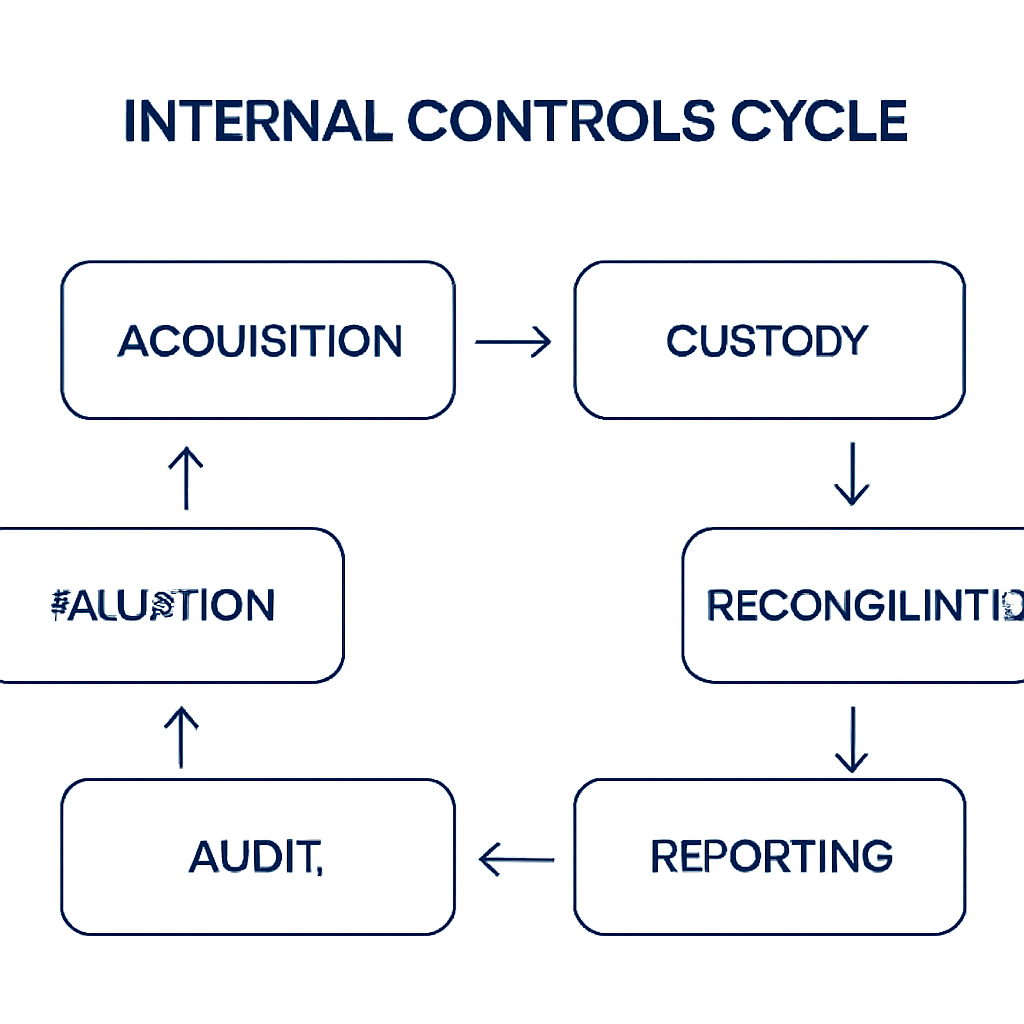
The core function of crypto accounting software in a control environment is to create a continuous, auditable bridge between on-chain activity and the general ledger. Without that bridge, finance teams are left manually extracting transaction data from exchanges and wallets, reconciling it against their own records, and calculating cost basis and unrealised gains by hand. Each of those manual steps is a control failure waiting to happen.
Automating Journal Entries and Exceptions
A well-implemented digital asset accounting software solution ingests transaction data directly from wallets and exchanges via API or blockchain node, applies the organisation's chosen cost basis methodology (FIFO, LIFO, or specific identification depending on jurisdiction and policy), generates journal entries automatically, and flags exceptions that require human review. That workflow turns what was previously a high-risk manual process into a governed, repeatable procedure with a clear audit trail.
Role-Based Access and Policy Management
Role-based access controls within the software enforce the segregation of duties discussed above. Read-only access for auditors, approval workflows for journal posting, and administrator-level controls over cost basis methodology changes all contribute to a control environment that can be demonstrated to external reviewers. When an auditor asks how a particular gain was calculated, the answer is traceable through the system rather than dependent on a spreadsheet someone may have modified.
For firms deploying enterprise crypto accounting software across multiple clients or entities, centralised policy management is equally important. The ability to apply consistent cost basis rules, consistent chart of accounts mappings, and consistent reporting formats across a portfolio of entities reduces the risk of methodological inconsistency, which is itself a form of control weakness. A dedicated crypto sub-ledger for digital asset reconciliation provides that consistency layer without requiring each entity to maintain its own bespoke process.
Wallet Reconciliation and Completeness Controls
Completeness is one of the five financial statement assertions that auditors test. For digital assets, completeness means that every wallet the organisation controls, whether on a centralised exchange, a hardware device, or a smart contract, is captured in the accounting records. That sounds straightforward, but in practice it frequently is not. Wallets are easy to create and easy to forget, particularly in organisations where multiple teams have historically operated with autonomy over their crypto holdings.
Maintaining a Wallet Register
A wallet register, maintained as a living document and reconciled against the organisation's accounting records at each period end, is a basic but essential control. The register should record the wallet address, the custodian or exchange on which it is held, the authorised signatories, and the date of last reconciliation. Any wallet not appearing in the register should be flagged as an exception requiring investigation.
Continuous vs Periodic Reconciliation
Automated reconciliation tools within crypto accounting software can compare the on-chain balance of each registered wallet against the balance recorded in the sub-ledger, identifying discrepancies in real time rather than at period end. That shift from periodic to continuous reconciliation substantially reduces the window of time during which an error or misappropriation could go undetected. The following table summarises the key reconciliation controls and their frequency.
| Control Activity | Frequency | Responsible Party | Evidence Required |
|---|---|---|---|
| On-chain to sub-ledger balance reconciliation | Daily (automated) | Finance / system | Reconciliation report with variance log |
| Sub-ledger to general ledger reconciliation | Monthly | Finance Controller | Signed reconciliation workpaper |
| Wallet register review | Quarterly | CFO or delegated reviewer | Updated register with sign-off |
| Access rights review | Quarterly | IT / Finance | User access listing, changes documented |
| Cost basis methodology review | Annually | Crypto accountant or external advisor | Written methodology statement |
Valuation Controls and Fair Value Measurement
Valuation is one of the most technically complex areas of digital asset accounting. The accounting treatment for crypto holdings differs across standards: IFRS currently requires most holdings to be held at cost less impairment under IAS 38 unless the entity qualifies for the commodity broker-trader exemption, while US GAAP, following the FASB's ASU 2023-08, requires fair value measurement for certain digital assets with changes recognised in net income. The standard that applies depends on the entity's jurisdiction and reporting framework.
Price Source and Observation Time
Regardless of the applicable standard, valuation controls must address three questions: which price source is used, at what time the price is observed, and how the price is documented. Using a single exchange's spot price introduces concentration risk, particularly for less liquid assets where spreads can be significant. Using the average of several reputable sources, documented at a consistent observation time, is a more defensible approach.
IFRS vs US GAAP Treatment
The following table illustrates how the treatment differs across the two major frameworks currently in effect.
| Framework | Default Treatment | Impairment | Gain Recognition |
|---|---|---|---|
| IFRS (IAS 38) | Cost less impairment (intangible asset) | Yes, one-directional | On disposal only |
| US GAAP (ASU 2023-08) | Fair value (in-scope assets) | N/A under fair value model | Each reporting period |
| IFRS (broker-trader exemption) | Fair value less costs to sell | N/A under fair value model | Each reporting period |
Monitoring Controls and the Role of the Crypto Accountant
Controls do not operate themselves. The monitoring component of the COSO framework requires that someone with appropriate knowledge reviews whether controls are functioning as designed and investigates when they are not. For digital assets, that responsibility typically falls to a crypto accountant, whether in-house or an external advisor, who combines accounting technical knowledge with an understanding of how blockchain transactions work.
Reviewing Exception Reports and Reconciliations
Monitoring activities for digital assets include reviewing system-generated exception reports, testing that automated reconciliations are picking up all wallets in scope, confirming that journal entries generated by the accounting software agree to the underlying on-chain data, and reviewing whether the cost basis methodology continues to be applied consistently. Where the organisation uses a third-party exchange or custodian, monitoring should also include periodic review of the custodian's controls, such as reviewing SOC 1 or SOC 2 reports where available.
Internal Audit for Digital Assets
Internal audit functions are increasingly being asked to include digital assets in their scope. A crypto accountant acting as an internal or co-sourced resource can support that work by translating blockchain-specific risks into the language of a conventional internal audit programme. The output of that programme, documented testing, identified weaknesses, and management responses, feeds directly into the audit committee's oversight of financial reporting risk.
Illustrative Scenario
This scenario is illustrative. It does not describe a real person or client, and the figures are examples only.
To illustrate how this applies in practice, consider the following scenario:
Michael is the CFO of a mid-sized technology company based in the United States that holds bitcoin and ether on its balance sheet, acquired over the previous two financial years. Ahead of the company's annual external audit, Michael's auditors flag that the digital asset reconciliation process relies entirely on manual exports from two exchange accounts, with cost basis calculations maintained in a shared spreadsheet. There is no clear evidence that the same individual is not both extracting the data and posting the journal entries, raising a segregation of duties concern.
Michael engages CryptaCount to implement a crypto sub-ledger that connects directly to both exchanges via API. The system imports historical and current transactions, recalculates cost basis under FIFO in line with the company's documented policy, and generates journal entries that post to the ERP only after a second reviewer approves them. Role-based access ensures the exchange administrator cannot also approve postings. By the time the auditors return, the reconciliation workpapers are system-generated, traceable to the chain, and supported by a clear access log. The segregation concern is resolved, and the audit proceeds without a material control finding.
Frequently Asked Questions
What is crypto accounting software and why do finance teams need it?
Crypto accounting software automates the ingestion of digital asset transaction data from wallets and exchanges, calculates cost basis, generates journal entries, and produces audit-ready records. Finance teams need it because manual processes are error-prone, slow, and difficult to defend to auditors when transaction volumes are significant.
How does crypto accounting software support internal controls?
It enforces segregation of duties through role-based access, creates an automated audit trail for every transaction, flags reconciliation exceptions in real time, and applies cost basis methodology consistently. These features turn what would otherwise be high-risk manual processes into governed, repeatable procedures.
What is a crypto sub-ledger and how does it differ from the general ledger?
A crypto sub-ledger is a dedicated ledger that records digital asset transactions in detail, including wallet addresses, on-chain references, cost basis, and fair value movements, before summarising them into the general ledger. It provides the granularity needed for audit and reconciliation without cluttering the main accounting records.
What cost basis methods are available in digital asset accounting software?
Most enterprise crypto accounting software supports FIFO (first in, first out), LIFO (last in, first out), and specific identification. The choice of method depends on the applicable tax jurisdiction and accounting standard. Once a method is selected, it should be applied consistently and documented in a written policy.
How should an organisation handle wallets held at third-party custodians?
The organisation should obtain transaction reports from the custodian and reconcile them against its own sub-ledger records at each period end. It should also request and review the custodian's SOC 1 or SOC 2 report where available, to assess whether the custodian's own controls are sufficient to rely upon.
What is the difference between IFRS and US GAAP treatment of digital assets?
Under IFRS, most digital assets are treated as intangible assets at cost less impairment, with gains recognised only on disposal. Under US GAAP, following ASU 2023-08, certain in-scope digital assets are measured at fair value with changes recognised in net income each period. The applicable treatment depends on the entity's reporting framework.
How often should a finance team reconcile its digital asset holdings?
Best practice is to run automated on-chain to sub-ledger reconciliations daily, with a formal sub-ledger to general ledger reconciliation at each monthly close. The wallet register should be reviewed quarterly, and cost basis methodology should be confirmed annually or whenever accounting standards change.
What qualifications should a crypto accountant have?
A crypto accountant should hold a recognised accountancy qualification such as ACA, ACCA, or CPA, combined with demonstrable knowledge of blockchain transaction mechanics, applicable accounting standards for digital assets, and the tax reporting obligations relevant to the entity's jurisdiction. Experience with crypto bookkeeping software is increasingly expected by audit committees.
Is best crypto accounting software suitable for small firms as well as large enterprises?
Yes. While enterprise crypto accounting software is designed to handle high transaction volumes, multi-entity structures, and complex cost basis requirements, smaller firms and sole practitioners can also benefit from automated reconciliation and journal generation. The key is selecting a platform that scales with the volume and complexity of the digital asset activity.
How does digital asset accounting software help with audit readiness?
It produces a complete, traceable record linking every balance sheet figure back to on-chain transaction data, with timestamps, wallet references, and methodology documentation. Auditors can verify balances independently against the blockchain, and the system's access log demonstrates that the controls were operating throughout the period under review.
Source: CryptaCount