
Amundi Tokenizes a €22.8bn Equity Index Fund: Accounting Impact
Amundi has launched a tokenized share class on the sub-fund behind one of Europe's most widely held equity ETFs, and that changes who needs to think about on-chain records. Tokenization has so far lived mostly in cash-like products. Now a €22.8 billion European equity index fund has an Ethereum-issued share class, which means accounting teams, auditors and CFOs may soon hold positions that sit on a public blockchain but behave like regulated fund units. Crypto accounting software that can only handle coins and tokens in isolation will struggle with that hybrid. The software has to link a token balance to a fund register, a custody record and a valuation.

What Amundi launched and how it is built
Amundi has added a tokenized share class to its Core STOXX Europe 600 index fund. According to Ledger Insights, the sub-fund is the one behind one of Europe's most widely held equity ETFs, with €22.8 billion in assets under management. The new share class is issued on public Ethereum. CACEIS acts as both transfer agent and tokenization agent. The report describes it as the first large European equity index fund to add a blockchain-based share class.
Those details matter more than the headline. A share class is a legal and administrative layer of an existing fund, not a separate product with its own portfolio. The underlying holdings stay the same. What changes is the way ownership of units is recorded and transferred. Putting a transfer agent and a tokenization agent in the structure signals that the token is meant to mirror the official fund register, with an established institution responsible for keeping the two aligned.
The roles in the structure
Three parties show up in the source description, and each one creates a different record a finance team may need to obtain.
- Amundi is the fund sponsor and issuer of the share class.
- CACEIS is the transfer agent and tokenization agent, so it sits at the point where the register and the token meet.
- Public Ethereum is the network on which the share class is issued, which makes the token visible on a public ledger.
The source does not set out the minimum subscription size, the eligible investor base, fees, settlement cycle or whether the token can move freely between wallets. Anyone planning to hold the share class should get those terms from the fund documentation rather than assume them.
Why public Ethereum is the notable choice
Issuing on a public network rather than a closed one means the token's transfer history is observable by anyone with a block explorer. For an accountant, that is both a benefit and a burden. It gives an independent record of movements that auditors can inspect. It also means wallet addresses, transaction hashes and gas costs enter the evidence trail alongside conventional fund statements. Teams that already handle digital asset ledgers will recognise that evidence. Teams that do not will need tooling and procedures before the first position is booked.
How this extends Amundi's tokenization program
The equity index launch is the latest step in a sequence. Ledger Insights frames it as an extension of Amundi's tokenization work beyond cash and into equity index investing, following three cash-focused initiatives over the past year.
The earlier cash-focused steps
In November 2025, Amundi added a tokenized share class to its money market fund. It then developed tokenized money market fund share classes with CACEIS, and built a setup for a fintech group's intra-group treasury so that liquidity could move between that group's entities on chain in real time. In March, Amundi became delegated investment manager of the Fund (SAFO), a total return swap product inside Spiko's French SICAV. The source says that product has gathered roughly $2.5 billion and is the largest within Spiko's tokenized fund platform.
Read in order, the pattern is clear. Tokenized money market units are easy to understand as cash management tools. A tokenized equity index share class is different. It carries market price risk, it is typically held for longer periods, and it is more likely to sit on a balance sheet as an investment than as a liquidity buffer. That shifts the accounting questions from cash management and treasury controls toward investment classification, fair value measurement and disclosure.
What the sequence signals to finance teams
One reasonable reading is that asset managers and their service providers are building repeatable tokenization infrastructure rather than running one-off pilots. The same transfer agent appears across several of the initiatives described. When the same operating model gets reused for products with different risk profiles, the likelihood that clients will encounter tokenized fund units in ordinary treasury and investment mandates goes up. That is an inference from the pattern, not a statement in the source, and it is worth treating as a planning assumption rather than a forecast.
Accounting implications for firms, auditors and CFOs
None of the source material addresses accounting treatment, so what follows is analysis of what a tokenized fund share class is likely to demand from a finance function, not a statement of what any regulator or standard-setter has ruled. Always confirm the applicable framework for your entity and jurisdiction.
Classification and measurement come from the fund unit, not the token
A common mistake with tokenized instruments is to treat them as crypto assets because they live on a blockchain. The economic substance here is a unit in a regulated equity index fund. The sensible starting point is to ask what rights the holder has against the fund and its assets, then apply the framework that fits that right. The technology used to record ownership does not by itself determine the classification. Documenting that judgement, and the reasoning behind it, is the kind of memo auditors will ask for.
Valuation follows the same logic. The fund's net asset value, not an exchange price for the token, is the more natural anchor for a unit of this type. If a secondary market price for the token ever diverges from net asset value, teams will need a policy for which input governs and how differences are explained.
Existence, ownership and the three-way reconciliation
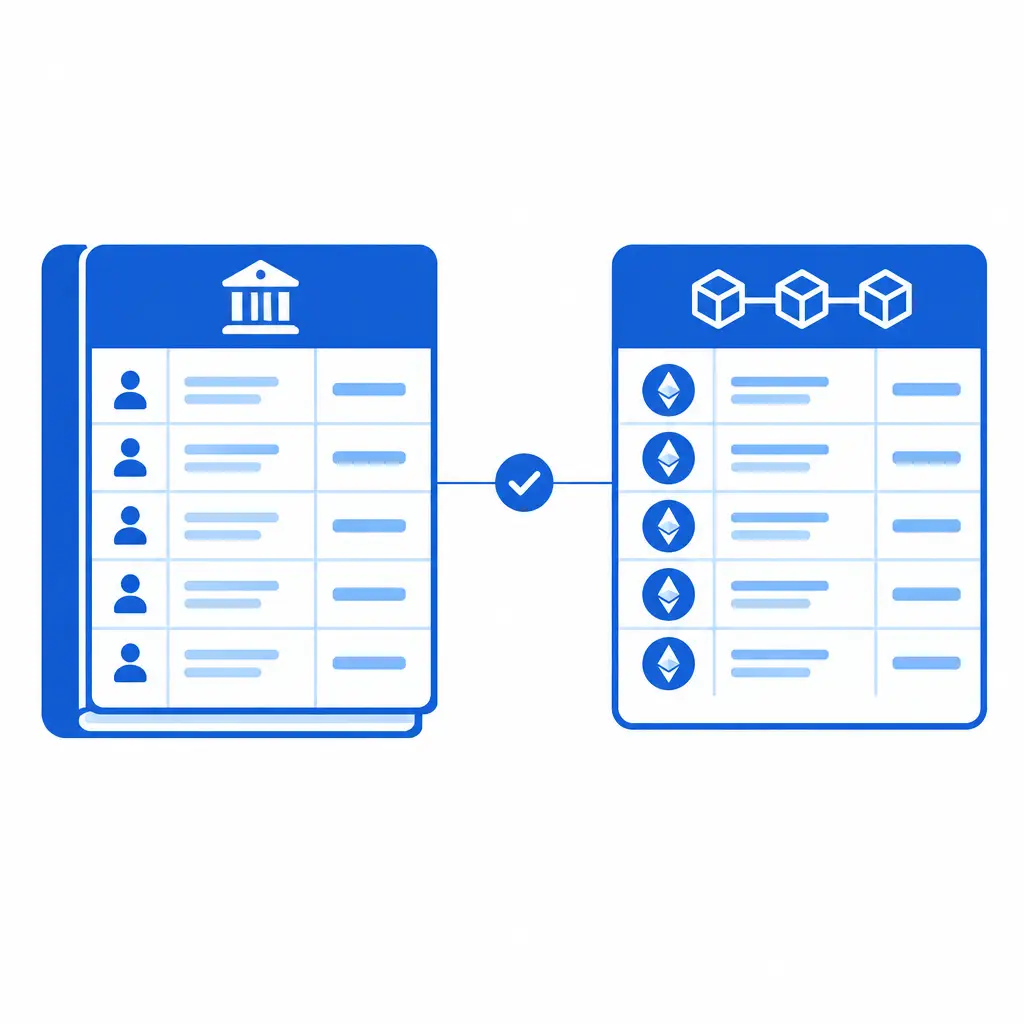
The control that matters most is reconciliation across three sources: the on-chain token balance, the transfer agent's register, and the custody or wallet records of the holder. Any one of these can drift from the others because of timing differences, failed transfers or wallet access issues. A sound process should:
- Capture the token contract address and the wallet addresses that hold the position.
- Obtain transfer agent statements on a defined schedule.
- Match on-chain balances to those statements and investigate breaks.
- Record who controls the keys, since control of the wallet is part of evidencing ownership.
This is precisely where crypto bookkeeping software and digital asset accounting software earn their place. They can ingest on-chain data, tag wallets and contracts, and produce a ledger that an auditor can trace. What they cannot do on their own is decide the accounting policy or obtain the transfer agent's confirmation. Those remain human responsibilities.
Custody, gas costs and operational records
Holding a unit on a public network introduces costs and risks that a traditional fund holding does not. Network fees paid to move or redeem tokens need a consistent treatment, whether capitalised into cost or expensed, and that policy should be written down. Key management is an operational risk that belongs in the control environment. If a third-party custodian holds the keys, the firm should understand what independent assurance it can obtain over that custody arrangement.
Tax and AML considerations to raise early
The source is silent on tax and anti-money laundering treatment, so none of the points below should be read as part of the announcement. They are questions a prudent team should put to advisers before holding the share class.
Tax questions for the B2B and B2C reader
For a corporate or fund-of-funds holder, the main questions are how gains on the unit are recognised, whether on-chain transfers between the firm's own wallets create any taxable event, and how withholding on distributions, if any, is handled across the relevant EU jurisdictions. Because the classification of tokenized fund units for tax can differ from their accounting classification, the two should be analysed separately.
For individual investors who may later gain access through platforms, the practical issue is record keeping. A holder who moves a tokenized unit between wallets, or redeems it, will want a clean record of dates, quantities and values in euro. Individuals should not assume the tax authority will treat a tokenized unit like a crypto coin, or exactly like a conventional fund unit, without checking local guidance. Whether and how retail investors can buy this particular share class is not stated in the source.
AML and sanctions screening on a public chain
Because the token is issued on public Ethereum, counterparties can in principle be identified only by wallet address. Institutions that hold or distribute the share class will still need to know who they are dealing with and screen wallets against sanctions lists. The controls that apply to digital asset activity more broadly, including wallet screening and source of funds checks, are a reasonable model. Recent coverage on this site of exchange hacks and laundering patterns shows why on-chain monitoring is now routine, and the same discipline applies when the asset is a regulated fund unit rather than a coin. See our look at what finance teams must prepare for as DTCC pushes tokenization for a related market-structure view.
What to do now: a practical checklist
Nothing in the source requires immediate action by a firm that does not hold the share class. The launch is still a useful prompt to test whether your processes could cope if a client or your own treasury did. The wider picture of how regulators and market infrastructure are treating tokenization is also moving, as shown by Hong Kong's SFC tokenisation push, so it pays to track developments outside the EU too.
For accounting firms and auditors
- Add tokenized fund units to your client onboarding questions, so you learn about holdings early.
- Prepare an audit programme that covers existence and ownership through the register, the chain and the wallet.
- Decide what evidence you will accept from a transfer agent and tokenization agent, and how you will test it.
For CFOs and finance teams
- Draft a policy for classification, measurement and disclosure of tokenized fund units, separate from your coin policy.
- Check whether your crypto compliance reporting process can carry a fund-unit position alongside native digital assets.
- Test your crypto accounting software against a mixed ledger, where one position has an on-chain identifier and an off-chain register.
- Confirm key custody, signing authority and wallet segregation before any position is opened.
What to watch next
Three developments are worth tracking. First, whether other large European managers follow with equity or bond share classes. Second, whether the fund documentation clarifies transferability and secondary trading. Third, whether regulators or standard-setters publish guidance on the accounting and reporting of tokenized fund units. The source does not report any of these, so treat them as watch items, not expectations.
FAQ
What exactly did Amundi launch?
It added a tokenized share class to its Core STOXX Europe 600 index fund. The share class is issued on public Ethereum, with CACEIS as transfer agent and tokenization agent. The source says the sub-fund has €22.8 billion in assets under management.
Is this a crypto asset for accounting purposes?
The source does not address accounting treatment. The sensible approach is to look at the rights the holder has in the fund and apply the framework that fits those rights, rather than classify the unit as a crypto asset only because it is recorded on a blockchain. Confirm the position with your auditor and the framework that applies to you.
Why does it matter for crypto accounting software?
A tokenized fund unit has an on-chain identity and an off-chain register. Crypto accounting software and digital asset accounting software need to capture wallet and contract data and still allow reconciliation to a transfer agent's records. Tools that treat every on-chain balance as a coin will miss the fund-unit economics.
Does the source say anything about tax or AML rules?
No. The report covers the launch and Amundi's wider tokenization program. Tax and AML points in this article are questions to raise with advisers, not statements about the announcement.
Can individual investors buy the share class?
The source does not say who is eligible to subscribe. Anyone interested should read the fund's official documentation and speak to their platform or adviser before assuming access.
Source: Ledger Insights