
FASB Crypto Fair Value vs IFRS: What Accountants Need to Know
The way a company accounts for crypto assets on its balance sheet depends entirely on which reporting framework it follows. For accounting firms and finance teams working across borders, the gap between FASB crypto fair value rules under US GAAP and the treatment prescribed under IFRS is not academic. It affects how gains are recognised, how impairment is handled, and what investors see when they read audited financial statements. Since the Financial Accounting Standards Board finalised ASC 350-60 in late 2023, with mandatory adoption from fiscal years beginning after 15 December 2024, the divergence between the two frameworks has widened in a meaningful way. Understanding both positions is now a core competency for any practice advising clients who hold, issue, or transact in digital assets.

How IFRS Crypto Assets Have Been Treated Historically
Under IFRS, no standard addresses crypto assets directly. The IASB has so far declined to create a dedicated cryptocurrency standard, meaning preparers must apply judgement and select the most appropriate existing standard based on the nature of the asset and how it is held. In practice, the two frameworks most commonly applied are IAS 38 Intangible Assets and IAS 2 Inventories.
Common Classification Under IAS 38
Entities that hold crypto assets for investment purposes, without any intention of selling them in the ordinary course of business, typically classify them as intangible assets under IAS 38. The standard permits either the cost model or the revaluation model for subsequent measurement. However, the revaluation model under IAS 38 is only available when an active market exists for the asset. Where an active market can be demonstrated, an entity may revalue crypto holdings to fair value, but any upward revaluation flows through other comprehensive income rather than profit or loss, unless it reverses a previously recognised impairment. Downward movements are recognised in profit or loss immediately. This creates an asymmetry: losses hit the income statement quickly, while gains are largely sheltered from it.
Entities that trade or broker crypto assets as part of their core business activity may instead classify holdings as inventories under IAS 2, measuring them at the lower of cost and net realisable value, unless they qualify as commodity broker-traders who are permitted to measure at fair value less costs to sell.
The result is a patchwork approach. Two IFRS-reporting companies with identical crypto holdings can produce very different financial statements depending on their chosen accounting policy and the active market assessment they make. This inconsistency has been a recurring frustration for auditors and investors alike.
ASC 350-60 and the FASB Crypto Fair Value Shift
The FASB took a decisive step when it finalised ASC 350-60, the first US GAAP standard to address crypto assets explicitly. The core requirement is straightforward: qualifying crypto assets must be measured at fair value at each reporting date, with changes in fair value recognised in net income in the period they occur. This applies to both unrealised gains and unrealised losses, symmetrically.
Core Fair Value Requirement
To qualify for treatment under ASC 350-60, an asset must meet specific criteria. It must be an intangible asset as defined under US GAAP, it must not give the holder a claim on underlying goods or services, it must reside on a distributed ledger or blockchain, it must be secured through cryptography, and it must be fungible. Assets that do not meet all of these criteria fall outside the scope of the standard and require separate accounting analysis. Non-fungible tokens, for example, are explicitly excluded.
The practical effect of the fair value model is significant. Companies holding Bitcoin or Ether on their balance sheets under US GAAP will now recognise every market movement through the income statement each quarter. A sharp rally in the fourth quarter will boost reported net income. A correction will reduce it. For firms advising listed companies or companies considering a public listing, this income statement volatility needs to be communicated clearly to boards and audit committees before adoption.
The standard also introduces specific disclosure requirements, including the carrying amount of each significant crypto asset holding, the cost basis, and the gains or losses recognised during the period. These disclosures go beyond what most companies have historically provided and will require systematic data collection from wallets and exchanges.
A Direct Comparison of Key Measurement Differences
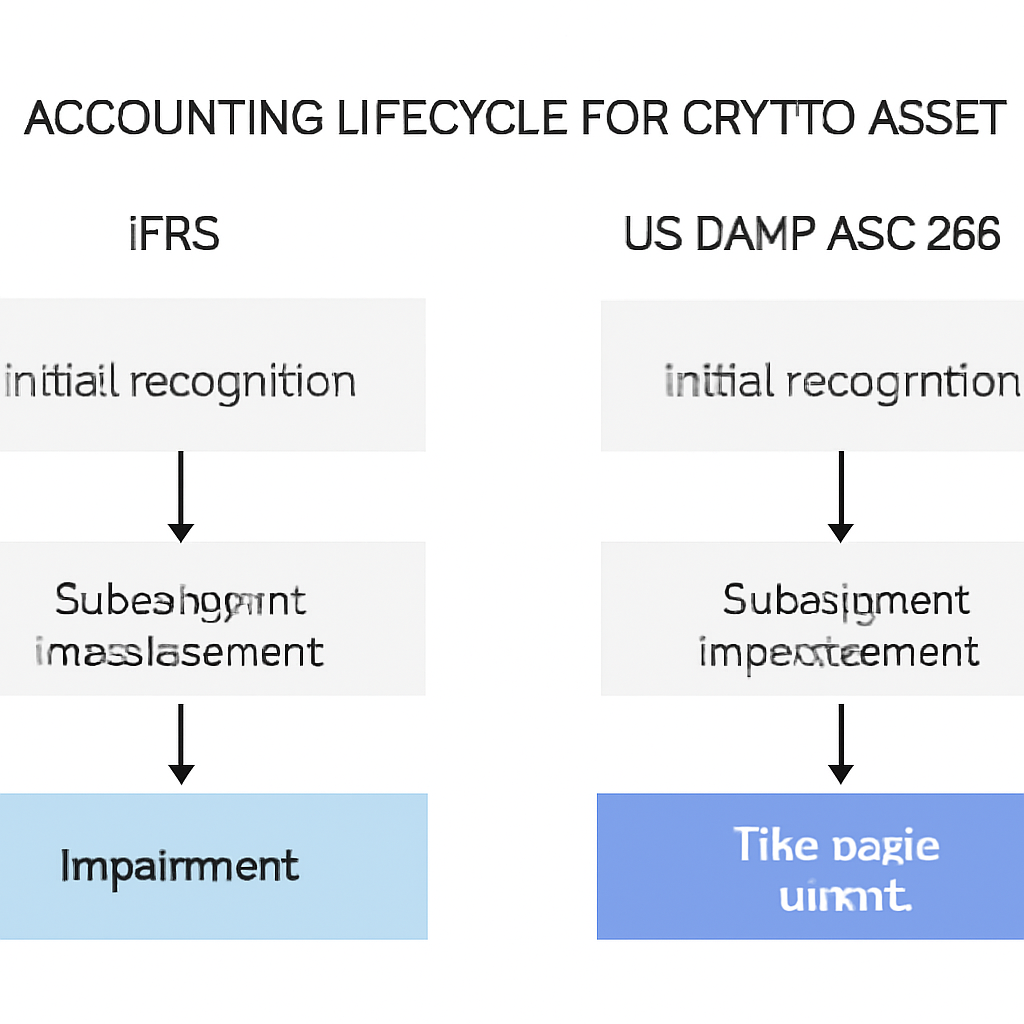
The table below summarises the most important divergences between IFRS and US GAAP crypto accounting, as they stand today. These differences matter most during audit fieldwork, when preparing group consolidations involving entities in multiple jurisdictions, and when advising clients on the financial statement impact of a crypto treasury strategy.
Key Differences at a Glance
| Feature | IFRS (IAS 38 / IAS 2) | US GAAP (ASC 350-60) |
|---|---|---|
| Dedicated standard | No: applies existing standards by analogy | Yes: ASC 350-60 effective for fiscal years after 15 Dec 2024 |
| Default measurement basis | Cost model under IAS 38 | Fair value at each reporting date |
| Revaluation upside in P&L | No: gains go to OCI under IAS 38 revaluation model | Yes: all fair value changes recognised in net income |
| Impairment requirement | Yes: tested under IAS 36 if cost model applied | Not applicable: fair value replaces impairment model |
| NFT treatment | Case by case under IAS 38 or IFRS 15 | Excluded from ASC 350-60 scope |
| Inventory classification available | Yes: IAS 2 for trading entities | Separate analysis required outside ASC 350-60 |
Implications for Crypto IFRS Accounting Under the Forthcoming IASB Project
The IASB is aware of the inconsistency in how IFRS preparers account for crypto assets, and the Board has a project on its agenda to address it. While no final standard has been issued, the direction of travel suggests the IASB may move toward a fair value model for certain categories of crypto assets, which would bring IFRS closer to the US GAAP position under ASC 350-60. However, the IASB has historically been cautious about mandating fair value through profit or loss for assets that management intends to hold long term, so the outcome is not a foregone conclusion.
IASB's Potential Fair Value Move
For accounting firms advising multinational clients, this uncertainty creates a practical challenge. Clients preparing IFRS financial statements today still need to make a policy choice between the cost model and the revaluation model under IAS 38, and that choice should be documented and applied consistently. If the IASB subsequently mandates a different approach, a change in accounting policy will be required, potentially with retrospective restatement. Advising clients now on the likely direction of the standard, and maintaining clean historical cost basis data, will reduce the disruption when that change arrives.
Maintaining a robust crypto sub-ledger and cost basis reconciliation from day one is the single most important step any finance team can take to future-proof their crypto accounting, regardless of which framework they follow.
How Disclosure Obligations Intersect with CARF and DAC8 Reporting
Accounting standard changes do not exist in isolation. At the same time as firms are navigating ASC 350-60 and the evolving IFRS position, the regulatory disclosure landscape is shifting significantly. The OECD's Crypto-Asset Reporting Framework, known as CARF crypto reporting, requires crypto-asset service providers to collect and report transaction data on their users to tax authorities in participating jurisdictions. The EU's DAC8 reporting directive transposes a version of CARF into European law, creating obligations for exchanges and custodians operating in EU member states.
Intersection With Tax Reporting
For accounting firms, the intersection of financial statement measurement and tax reporting is increasingly important. A client that holds crypto assets on its balance sheet at fair value under ASC 350-60 will recognise income statement movements that may or may not align with taxable gains under the applicable tax code. The timing differences between accounting recognition and tax recognition need to be tracked carefully to produce accurate deferred tax calculations. Similarly, where a client is itself a crypto-asset service provider, DAC8 reporting obligations sit alongside the accounting treatment of the assets they hold or administer.
Practices that build integrated workflows connecting financial reporting, tax position tracking, and regulatory reporting will be better placed to serve clients comprehensively and to identify advisory opportunities that purely compliance-focused engagements miss.
| Obligation | Scope | Who It Affects | Key Interaction with Accounting |
|---|---|---|---|
| ASC 350-60 | US GAAP reporters holding qualifying crypto | US-listed and US-reporting entities | Fair value movements create timing differences vs tax |
| CARF crypto reporting | Crypto-asset service providers in participating countries | Exchanges, custodians, brokers | Transaction data must align with accounting records |
| DAC8 reporting | EU-based crypto-asset service providers | EU exchanges and custodians | Reported values should reconcile to financial statements |
Practical Steps for Accounting Firms and CFOs
Firms advising clients on crypto asset accounting need a structured approach to avoid misstatements and manage audit risk. The starting point is always classification: understanding what the client holds, how it is held, and what framework applies. That classification drives every subsequent decision about measurement, disclosure, and tax treatment.
Start With Classification
For US GAAP reporters, the immediate priority is confirming which assets fall within ASC 350-60's scope and establishing a process for obtaining fair values at each reporting date. Fair value under ASC 350-60 follows the ASC 820 hierarchy, meaning Level 1 inputs from active markets are used wherever available. For assets traded on major exchanges, this is straightforward. For less liquid assets, the valuation methodology needs to be documented carefully and reviewed by auditors.
For IFRS reporters, the priority is documenting the accounting policy choice, obtaining evidence to support any active market assessment required for the revaluation model, and building a process to test for impairment under IAS 36 if the cost model is applied. Where clients hold a significant portfolio of crypto assets, automated reconciliation tools that pull data from exchanges and wallets directly into the ledger will reduce the manual effort and the risk of error.
In both frameworks, disclosure quality has become a differentiator. Auditors and investors are scrutinising crypto disclosures more closely than they were even two years ago. Firms that help clients build clear, complete disclosures from a well-maintained underlying data set will reduce audit friction and strengthen the client relationship.
Illustrative Scenario
This scenario is illustrative. It does not describe a real person or client, and the figures are examples only.
To illustrate how this applies in practice, consider the following scenario: Michael is the CFO of a mid-sized US technology company that began holding Bitcoin as a treasury asset during a prior fiscal year. The company reports under US GAAP and has a December fiscal year-end, meaning ASC 350-60 is mandatory for its current reporting cycle. Michael's external auditors have flagged that the company's existing accounting policy, which treated the Bitcoin holding as an indefinite-lived intangible asset under the old guidance with impairment-only write-downs, is no longer acceptable. The company must now recognise fair value movements through net income each quarter.
Michael engages his accounting firm to restructure the sub-ledger, pulling exchange data into a system that calculates fair value at each quarter-end using Level 1 prices and generates the disclosure tables required under ASC 350-60. Using CryptaCount, the firm automates the data feed from the custody platform, maps it to the correct ASC 820 hierarchy level, and produces a draft disclosure note ready for audit review. The transition adjustment is calculated, the deferred tax position is updated, and the audit fieldwork is completed without the extended back-and-forth that characterised the prior year. Michael presents clean, fully compliant financials to the board on schedule.
Frequently Asked Questions
What is FASB crypto fair value accounting under ASC 350-60?
ASC 350-60 is the US GAAP standard that requires qualifying crypto assets to be measured at fair value at each reporting date, with changes recognised in net income. It applies to intangible, fungible, blockchain-based assets that do not convey a claim on underlying goods or services. The standard is mandatory for fiscal years beginning after 15 December 2024.
How does IFRS crypto asset treatment differ from US GAAP?
Under IFRS, there is no dedicated crypto asset standard. Entities typically apply IAS 38 Intangible Assets or IAS 2 Inventories depending on how the asset is held and used. Under the IAS 38 revaluation model, upward revaluations go through other comprehensive income rather than profit or loss, which contrasts sharply with the US GAAP fair value through net income approach under ASC 350-60.
Can an IFRS entity choose to measure crypto assets at fair value through profit or loss?
Not straightforwardly. The IAS 38 revaluation model routes gains through OCI, not profit or loss, unless they reverse a prior impairment. Commodity broker-traders applying IAS 2 may measure at fair value less costs to sell, which does affect profit or loss. For most investment holders, the current IFRS framework does not permit the same symmetric fair value through profit or loss treatment that ASC 350-60 mandates.
What disclosures does ASC 350-60 require?
The standard requires entities to disclose the carrying amount of each significant crypto asset holding, the cost basis, and the aggregate gains and losses recognised in net income during the period. These disclosures must be provided at a level of detail sufficient for users to understand the nature and scale of the company's crypto holdings and the income statement impact of fair value movements.
Does ASC 350-60 apply to NFTs?
No. Non-fungible tokens are explicitly excluded from the scope of ASC 350-60 because they do not meet the fungibility criterion. Entities holding NFTs must determine the appropriate accounting treatment separately, typically under existing intangible asset or other guidance depending on the nature of the token.
How does crypto IFRS accounting interact with impairment testing?
Where an IFRS entity applies the cost model under IAS 38, crypto assets must be tested for impairment under IAS 36 whenever there is an indication that the carrying amount exceeds the recoverable amount. Because crypto prices are volatile, impairment indicators arise frequently. Entities that apply the revaluation model avoid IAS 36 impairment testing but must maintain evidence of an active market to use that model at all.
What is the relationship between CARF crypto reporting and financial statement accounting?
CARF crypto reporting is a tax transparency framework requiring crypto-asset service providers to report user transaction data to tax authorities. It does not directly determine how crypto assets are measured in financial statements. However, the transaction records gathered for CARF compliance should reconcile to the figures in the accounting ledger, and any discrepancies create audit risk and potential regulatory exposure.
How should accounting firms prepare clients for ASC 350-60 adoption?
The first step is scoping which assets qualify under the standard and confirming the fair value hierarchy level applicable to each. Firms should then help clients establish an automated data feed from custodians and exchanges, build a process for quarter-end fair value capture, and draft the required disclosure notes. Documenting the transition adjustment and updating the deferred tax position are also critical workstreams before the first period-end under the new standard.
Will IFRS eventually adopt a fair value model similar to ASC 350-60?
The IASB has an active project on crypto assets and is considering whether a fair value model would better represent economic reality for holders. No final standard has been issued, and the timeline remains uncertain. Accounting firms should monitor IASB exposure drafts and help clients maintain detailed cost basis records now, so that any future policy change can be applied with minimal disruption to historical data.
Source: CryptaCount