
IFRS Crypto Assets: A Valuation Guide for Financial Reporting
Valuing crypto assets for financial reporting is no longer a niche problem confined to crypto-native businesses. As digital assets appear on the balance sheets of listed companies, SMEs, treasury functions, and investment vehicles worldwide, accountants and finance teams face a fundamental question: which standard applies, and what does it actually require? Under IFRS crypto assets guidance, there is no single dedicated standard that covers every type of digital asset. Instead, practitioners must work through a classification exercise before any measurement question can even be asked. The answer differs depending on whether the entity applies IFRS or US GAAP, and the practical consequences of getting that classification wrong range from misstated balance sheets to qualified audit opinions. This article sets out the current frameworks, explains where IFRS and US GAAP converge and diverge, and gives finance teams a structured basis for making defensible accounting decisions.

Why There Is No Single Standard for IFRS Crypto Assets
The IASB has not issued a dedicated IFRS standard for crypto assets, and that absence is deliberate. The Board concluded that most common cryptocurrencies, including Bitcoin and Ether, can be accommodated within existing standards without requiring new rules. The challenge is that existing standards were designed for financial instruments, intangible assets, and inventories, none of which map cleanly onto the behaviour of a decentralised digital token.
Default Application of IAS 38
For most entities holding crypto assets that are not held for sale in the ordinary course of business, IAS 38 Intangible Assets is the default landing point under IFRS. IAS 38 permits either the cost model or the revaluation model as an accounting policy. The revaluation model is only available where an active market exists for the asset, a condition that major cryptocurrencies traded on regulated exchanges can generally satisfy. Under the cost model, assets are carried at cost less any accumulated impairment. Under the revaluation model, they are carried at fair value at the revaluation date, with gains recognised in other comprehensive income rather than profit or loss, except to the extent they reverse a previously recognised impairment.
Inventory Classification Under IAS 2
Entities that hold crypto as inventory, for example crypto brokers or miners selling tokens in the ordinary course of business, apply IAS 2 Inventories instead. IAS 2 requires measurement at the lower of cost and net realisable value, with commodity broker-traders having the option to measure at fair value less costs to sell. The classification therefore drives the measurement, which drives the P&L impact. Finance teams need to establish the business model before they can even reach the valuation question.
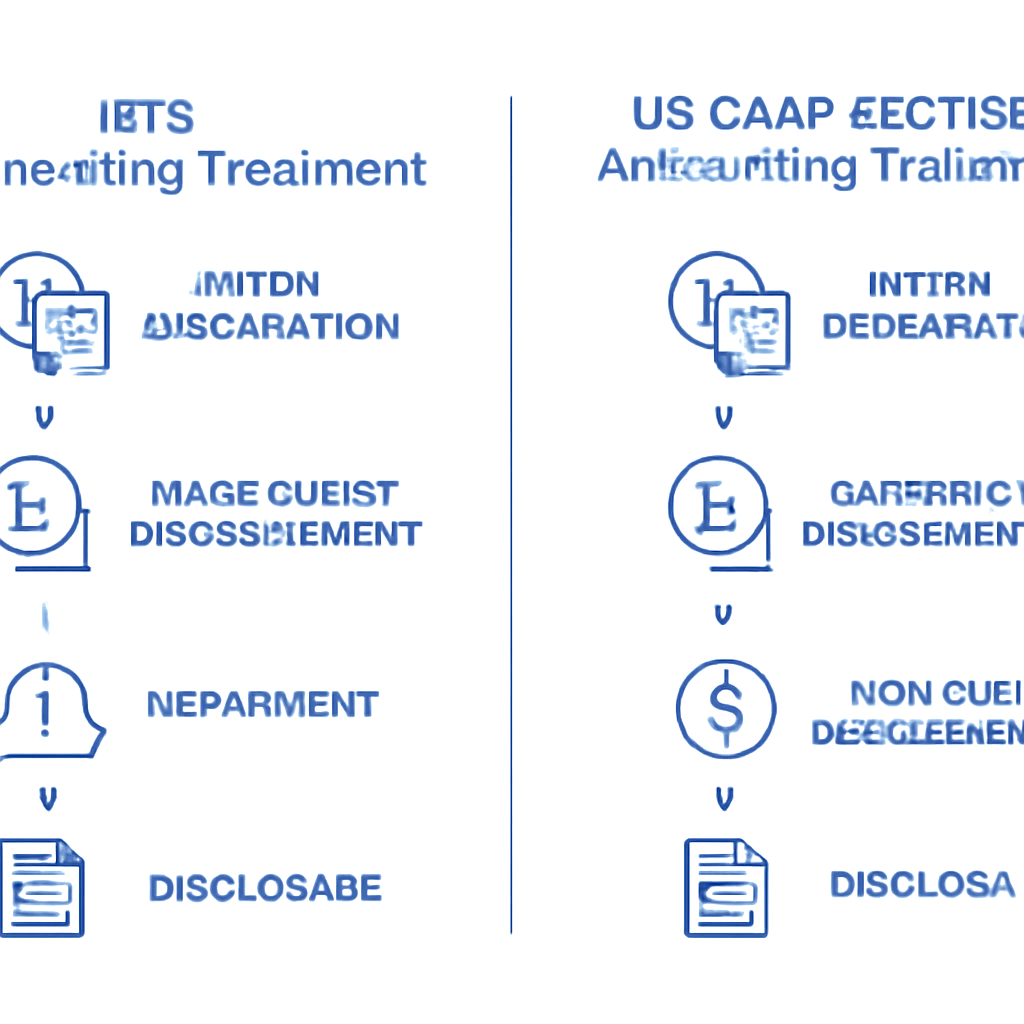
Crypto IFRS Accounting: Classification Decision Tree
The classification process under crypto IFRS accounting follows a logical sequence. Getting this sequence documented and auditable is as important as reaching the right answer, because auditors will ask for the reasoning, not just the conclusion.
Is It a Financial Instrument?
The first question is whether the crypto asset meets the definition of a financial instrument under IAS 32. For most pure cryptocurrencies, the answer is no, because they do not represent a contractual right to receive cash or another financial asset from another party. Stablecoins backed by fiat reserves and certain tokenised debt instruments may clear this bar, but standard cryptocurrencies do not.
Held for Sale or Investment?
The second question is whether the asset is held for sale in the ordinary course of business. If yes, IAS 2 applies. If no, the analysis moves to IAS 38, with the revaluation model available only where there is an active market. The table below summarises the main classification outcomes under IFRS.
| Asset Type | Applicable Standard | Measurement Basis | Gains/Losses |
|---|---|---|---|
| Cryptocurrency held as investment (no active market) | IAS 38 (cost model) | Cost less impairment | Impairment losses to P&L only |
| Cryptocurrency held as investment (active market exists) | IAS 38 (revaluation model) | Fair value at revaluation date | Gains to OCI; impairment reversals limited |
| Crypto held as inventory (broker/trader/miner) | IAS 2 | Lower of cost and NRV (or FV less costs to sell) | Changes to P&L |
| Tokenised financial instrument | IFRS 9 | Amortised cost or fair value | Depends on classification category |
ASC 350-60 Crypto and the US GAAP Approach
US GAAP took a different and more definitive step in 2023 when the FASB issued ASU 2023-08, which introduced ASC 350-60 as a dedicated subtopic for certain crypto assets. This update requires entities to measure qualifying crypto assets at fair value at each reporting date, with changes recognised in net income. That is a material departure from the old indefinite-lived intangible asset model that had required impairment-only write-downs and prohibited upward revaluations.
FASB Rationale for Fair Value
The FASB's rationale was straightforward. Crypto assets trade on active markets with readily determinable fair values, so requiring entities to carry them at impaired historical cost produced financial statements that were neither relevant nor representational. The new standard was effective for fiscal years beginning after December 15, 2024, with early adoption permitted.
Scope and Exclusions of ASC 350-60
Not every digital asset qualifies for ASC 350-60 treatment under crypto US GAAP accounting. The subtopic applies to assets that are intangible assets under US GAAP, are secured through cryptography, reside on a distributed ledger, and are fungible. NFTs, wrapped tokens with redemption rights, and assets that represent ownership in another entity generally fall outside the scope. Those exclusions matter because they push certain asset types back toward other GAAP frameworks, creating a mixed measurement environment for entities with diverse digital asset portfolios.
Under FASB crypto fair value requirements, entities must also provide tabular disclosures showing the fair value of each significant crypto asset holding, the cost basis, and cumulative unrealised gains and losses. These disclosures are more granular than anything previously required under US GAAP and will increase the data demands placed on finance and accounting teams.
IFRS vs US GAAP: Key Differences at a Glance
The divergence between IFRS and US GAAP on crypto asset measurement has real consequences for multinational groups, dual-listed entities, and accounting firms advising clients across both jurisdictions. The table below highlights the most significant practical differences.
Key Differences at a Glance
| Dimension | IFRS (IAS 38 / IAS 2) | US GAAP (ASC 350-60) |
|---|---|---|
| Dedicated standard | No | Yes, ASU 2023-08 |
| Default measurement for investment holdings | Cost less impairment (revaluation model optional) | Fair value through net income |
| Upward revaluation to P&L | Not permitted under IAS 38 | Required under ASC 350-60 |
| Impairment model | IAS 36 (for IAS 38 cost model) | Not applicable (fair value replaces) |
| Scope exclusions | Financial instruments assessed under IAS 32/IFRS 9 | NFTs, wrapped tokens, ownership instruments |
| Disclosure requirements | IAS 38 and IFRS 7 where applicable | Tabular fair value and cost basis disclosures |
Audit-Readiness and What It Requires in Practice
Audit readiness for crypto asset holdings goes well beyond selecting the correct accounting policy. Auditors need evidence, and evidence in the context of digital assets means on-chain transaction records, exchange statements, wallet reconciliations, and a defensible method for determining fair value at the measurement date.
Fair Value Determination Process
Fair value determination requires selecting an appropriate principal market or most advantageous market under IFRS 13, which for major cryptocurrencies typically means a regulated exchange. The entity must document which exchange it uses, why that exchange represents the principal market, and how it captures the closing price or volume-weighted average price at the balance sheet date. That documentation needs to be consistent period over period unless there is a legitimate reason to change.
Sub-Ledger and Cost Basis Tracking
For firms advising clients through crypto sub-ledger and cost basis tracking, the practical ask is even more demanding. Every acquisition, disposal, staking reward, fork, airdrop, and inter-wallet transfer needs to be classified, timestamped, and valued. Without a structured sub-ledger that maps to the general ledger, producing audit-ready schedules becomes a manual exercise that scales badly as transaction volumes grow.
The disclosure requirements under both IFRS and ASC 350-60 also assume that the entity can segment its portfolio by asset type, measure each holding at fair value, and reconcile movements in carrying value through the period. That level of granularity is not achievable from exchange CSVs alone.
Regulatory Reporting Layers: DAC8 and CARF
Valuation for financial reporting sits alongside, but is separate from, the emerging obligations under DAC8 reporting and CARF crypto reporting. Both frameworks require crypto-asset service providers and, in some jurisdictions, entities holding or transacting in crypto, to report user and transaction data to tax authorities. DAC8 applies across EU member states and has been transposed into national law, while CARF is the OECD's global standard that many jurisdictions are implementing through domestic legislation.
Data Overlap Between Reporting Frameworks
These reporting obligations do not directly dictate how entities measure crypto for financial statement purposes. However, they create a parallel data requirement that intersects with financial reporting. The transaction-level data needed to comply with CARF crypto reporting, including acquisition dates, cost bases, and proceeds, is the same data that feeds into cost basis calculations for accounting and tax purposes. Firms that build clean, structured data pipelines for crypto compliance reporting also reduce the manual effort required to produce financial statement disclosures. The two workstreams reward the same underlying data discipline.
Illustrative Scenario
This scenario is illustrative. It does not describe a real person or client, and the figures are examples only.
To illustrate how this applies in practice, consider the following scenario:
Priya is the Group Financial Controller at a mid-sized UK-headquartered asset management firm that began allocating a portion of its treasury to Bitcoin and Ether in the prior financial year. As year-end approaches, Priya needs to produce auditable financial statements under IFRS. The firm does not trade crypto in the ordinary course of business, so IAS 38 applies rather than IAS 2. Priya's team selects the revaluation model, since active markets exist for both assets, and must now document the principal market used for fair value, the closing price at the balance sheet date, and the policy for recognising revaluation gains in other comprehensive income.
The problem is that the firm's crypto holdings are spread across two exchanges and a cold storage wallet. Pulling consistent, timestamped valuations from three different sources, reconciling transfer activity between them, and producing a schedule that ties to the general ledger has consumed more audit-preparation time than anticipated. Priya implements CryptaCount's crypto sub-ledger module, which aggregates transaction data across all three sources, applies the firm's chosen pricing methodology consistently, and generates the reconciliation schedules the auditors need. The first year-end using the platform reduces the manual reconciliation work from weeks to days and produces disclosures that satisfy the audit team without a second request for information.

Frequently Asked Questions
What standard applies to IFRS crypto assets held as investments?
For most entities, IAS 38 Intangible Assets is the applicable standard when crypto is held as an investment rather than inventory. The cost model or revaluation model can be applied, with the revaluation model available only where an active market exists. Gains under the revaluation model go to other comprehensive income, not profit or loss.
Can IFRS entities recognise unrealised gains on crypto assets in profit or loss?
Not under IAS 38, which is the standard most commonly applied to crypto investment holdings. The revaluation model sends gains to other comprehensive income. Only entities applying IFRS 9 to tokenised financial instruments, or IAS 2 broker-trader exemptions, may recognise fair value movements in profit or loss.
What is ASC 350-60 and who does it apply to?
ASC 350-60 is the US GAAP subtopic introduced by FASB's ASU 2023-08 for certain crypto assets. It requires qualifying assets to be measured at fair value at each reporting date, with changes recognised in net income. It applies to fungible, cryptographically secured intangible assets on distributed ledgers, but excludes NFTs and ownership instruments.
How does FASB crypto fair value measurement differ from the old US GAAP model?
Under the previous US GAAP treatment, crypto assets were carried as indefinite-lived intangibles at historical cost less any impairment, meaning write-downs were permitted but upward revaluations were not. ASC 350-60 replaces that with mandatory fair value measurement, so both unrealised gains and losses flow through net income each period.
Do IFRS and US GAAP treat stablecoins the same way as other crypto assets?
Not necessarily. Stablecoins backed by fiat reserves may meet the definition of a financial instrument under IAS 32, which would bring them into IFRS 9 rather than IAS 38. Under US GAAP, stablecoins that represent a claim on another entity may fall outside ASC 350-60 scope. Each asset requires its own classification analysis.
What documentation do auditors expect for crypto asset valuations?
Auditors typically require evidence of the principal market used for fair value, the price source and timestamp at the measurement date, wallet and exchange reconciliations, and a consistent accounting policy document. Transaction-level records covering acquisitions, disposals, and transfers are also needed to support cost basis and impairment calculations.
How does DAC8 reporting relate to crypto financial reporting under IFRS?
DAC8 reporting is a tax authority data-sharing obligation applicable to crypto-asset service providers operating in the EU. It does not directly govern financial statement measurement. However, the transaction-level data required for DAC8 and CARF crypto reporting overlaps significantly with what is needed to produce auditable crypto disclosures, so a single structured data pipeline serves both purposes.
What is the CARF crypto reporting framework?
CARF, the Crypto-Asset Reporting Framework developed by the OECD, requires reporting entities to collect and transmit information about crypto transactions and account holders to tax authorities. It is being adopted by a growing number of jurisdictions through domestic legislation. The data it demands, including cost basis and disposal proceeds, mirrors what is needed for accurate financial reporting under both IFRS and US GAAP.
Can accounting firms use software to automate crypto asset valuations for clients?
Yes, and for clients with significant transaction volumes or multi-wallet, multi-exchange setups it is close to essential. Manual reconciliation of crypto data across multiple sources is error-prone and does not scale. Platforms that aggregate transaction data, apply consistent pricing methodologies, and generate audit-ready schedules allow firms to serve crypto clients efficiently while maintaining compliance with crypto ifrs accounting and US GAAP requirements.
Source: CryptaCount