
Clarity Act Senate Defeat: Banks and Dubai Win, US Firms Lose Ground
The US Senate's decision to block the Clarity Act has handed traditional banks a tangible short-term win and given regulated overseas jurisdictions, particularly the United Arab Emirates, a fresh competitive edge. For accounting firms, auditors, and CFOs managing digital asset portfolios, the defeat does not just mean more uncertainty over stablecoin classification. It means that the policy vacuum left by Congress will be filled, imperfectly, by the SEC and CFTC through interpretive guidance and exemptions rather than durable statute. Stablecoin accounting and the broader question of how to treat digital assets on the balance sheet remain genuinely unresolved under US federal law.
What the Clarity Act Would Have Done
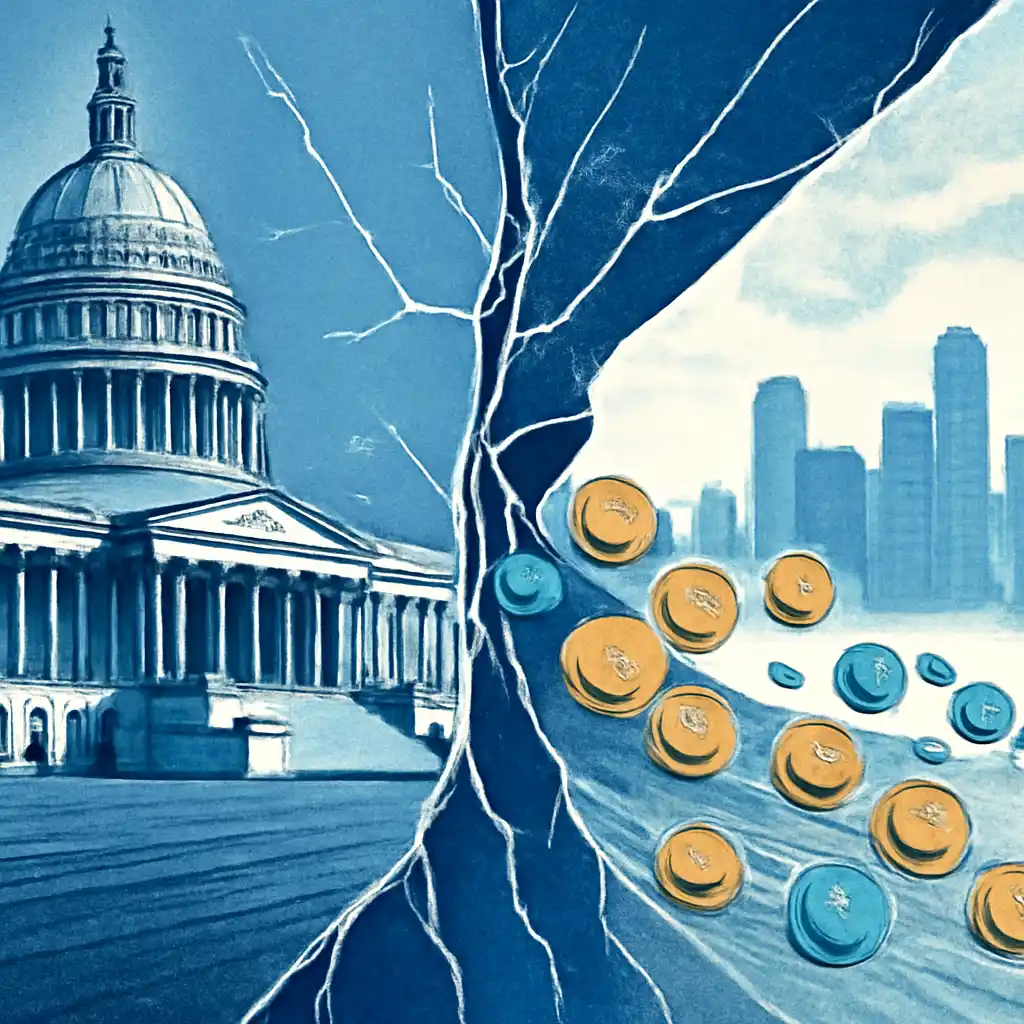
The Clarity Act was intended to provide a federal market-structure framework for digital assets, one that would have assigned clear regulatory jurisdiction, defined which assets fall under the SEC versus the CFTC, and set statutory ground rules for stablecoin issuers. Its failure means none of those outcomes materialise through legislation. The two agencies revert to their existing toolkits: interpretive letters, exemptions, enforcement actions, and guidance documents that can be revised or withdrawn at any administration's discretion.
The stablecoin yield dispute at the centre
A significant flashpoint within the legislative debate was whether stablecoin platforms should be permitted to pass yield to holders, effectively allowing stablecoins to function as interest-bearing instruments in competition with bank deposits. Banks lobbied hard against this. Their argument is straightforward: if a regulated stablecoin can pay a return backed by short-duration Treasuries or similar assets, it starts to look and function like a deposit account, drawing retail and institutional funds away from the banking system.
Anton Golub, head of exchange go-to-market at Forte, framed it plainly: banks "increasingly see stablecoins as competition for deposits, not just as another crypto product." The Senate vote, whatever its precise motivation, had the effect of preserving the existing prohibition on yield-bearing stablecoins at the federal level. That outcome matters for USDC accounting and for any firm modelling the tax and revenue treatment of stablecoin positions, because yield-bearing structures carry very different accounting and tax profiles than non-interest-bearing equivalents.
Regulatory authority reverts to the agencies
In the immediate aftermath of the Senate vote, the SEC moved to use its existing authority rather than wait for Congress. The agency issued an exemption allowing eligible venues to trade tokenised US stocks through permissioned liquidity pools on public blockchains. The CFTC, for its part, sent a crypto asset rulemaking package to the White House Office of Information and Regulatory Affairs for review. Neither action provides the statutory certainty that the Clarity Act would have created. Both are agency-level measures, subject to change through future rulemakings, court challenges, or shifts in agency leadership.
For compliance teams, the implication is that any internal policy built on current SEC or CFTC guidance carries more revision risk than one grounded in statute. That affects how firms document their accounting judgements, particularly around asset classification under ASC 350 or IFRS equivalent standards.
Banks: The Immediate Domestic Beneficiaries
The banking sector's win is defensive rather than strategic. By preventing stablecoin issuers from offering yield, the legislative outcome protects banks' deposit franchise, at least domestically and at least for now. This matters to accounting and finance teams at banks and their counterparts in accounting practice because it defines the competitive landscape for the next legislative cycle.
What this means for deposit accounting and risk assessment
Banks that had been stress-testing scenarios involving significant deposit outflows to yield-bearing stablecoins can, for the moment, reduce the weight on those tail scenarios. However, the underlying competitive threat has not disappeared. It has simply been deferred. Any accounting firm advising a banking client on liquidity risk modelling or deposit stability disclosures should note that the stablecoin yield question is likely to return in future legislative sessions, with or without the Clarity Act branding.
Firms using digital asset accounting software to track stablecoin holdings should also revisit classification logic. Without a clear federal definition, the treatment of a stablecoin as a cash equivalent, a financial asset, or an intangible asset remains a judgement call subject to auditor scrutiny. The SEC's existing staff guidance and FASB ASU 2023-08, which requires fair-value measurement of certain crypto assets, remain the operative references for now.
The UAE and Other Regulated Hubs: The Offshore Winners
The global dimension of the Clarity Act's defeat may prove more consequential in the medium term than the domestic banking outcome. Irina Heaver, a Dubai-based crypto lawyer and founder of NeosLegal, stated directly: "While the U.S. continues debating the Clarity Act, in the UAE we actually have clarity." She noted that more than 110 regulated virtual-asset businesses operate in the country, with approximately 20 more holding in-principle approvals.
Regulatory arbitrage is already happening
The UAE's Virtual Assets Regulatory Authority (VARA) and the Dubai Financial Services Authority (DFSA) in the DIFC have both published detailed, operational frameworks for crypto asset service providers. Firms that are structuring international operations can obtain licences, hire compliantly, and account for digital assets under rules that are written down and stable. That is a material difference from operating in a jurisdiction where the boundaries of securities law as applied to digital assets are still being argued in federal courts and agency guidance documents.
Kyle Bligen, executive director at the Decentralization Research Center, acknowledged that the Senate vote "was disappointing, but it does not change the underlying problem: digital assets still need clear and durable rules." He added that Congress remains the most reliable route to a comprehensive market structure framework. Until that framework arrives, jurisdictions with functioning regimes continue to attract the businesses, founders, talent, and capital that the US is, at least temporarily, pushing away.
For CFOs and finance directors at firms with a choice of domicile or operational base, this dynamic requires active modelling. The cost of maintaining dual regulatory compliance across a US entity and a UAE entity needs to be weighed against the benefit of accessing clearer rules in the UAE for certain digital asset activities. That calculation has shifted, at least marginally, following the Senate vote.
Accounting and Tax Implications for Firms
The absence of a statutory framework does not suspend accounting obligations. Firms holding stablecoins, issuing them, or accepting them as payment still need to apply existing standards and make defensible judgements. Several areas deserve immediate attention from finance and compliance teams.
Stablecoin classification under current standards
Under FASB ASU 2023-08, in-scope crypto assets are measured at fair value with changes recognised in net income each period. Stablecoins that are not within the standard's scope (because they do not meet the definition of an intangible asset or because they convey contractual rights to receive another asset) require separate analysis. The Clarity Act would have helped standardise that analysis. Without it, firms must document their classification rationale with more care, particularly if the stablecoin in question carries any yield or redemption feature that could recharacterise it as a financial instrument under ASC 860 or IFRS 9.
USDC accounting in practice
USDC, the largest regulated dollar stablecoin, is currently treated by most US preparers as either a cash equivalent or an intangible digital asset depending on the holding period and operational purpose. That treatment has not changed as a result of the Senate vote, but the uncertainty around whether future stablecoin regulation will impose new disclosure or capital requirements creates a contingent liability disclosure question for some issuers and large holders. Auditors should prompt clients to consider whether any forward-looking disclosures in annual reports or 10-K filings need to be updated to reflect the legislative outcome.
Tax treatment: nothing has changed, and that is the problem
The IRS treats stablecoins as property. Every exchange of a stablecoin for another asset, including another stablecoin, is a potentially taxable disposition requiring recognition of gain or loss. The Clarity Act did not contain sweeping tax reform provisions, so its defeat does not directly alter the IRS position. However, the continued absence of a legislative framework means there is no pressure on Congress to address the widely criticised "property" classification, which creates a compliance burden disproportionate to the economic risk of holding a dollar-pegged instrument. Firms advising clients on stablecoin use in treasury operations should continue to flag this, document every transaction with cost basis, and watch for any IRS guidance that might emerge through the Notice or Revenue Ruling process.
For firms that want to understand how the CFTC's parallel rulemaking effort fits into this picture, our coverage of how the CFTC's crypto rulemaking reached the White House after the Clarity Act stalled provides relevant context on the agency's current posture.
What Firms Should Do Now
The Senate vote does not call for panic, but it does call for a structured review of existing positions and policies. Several actions are worth prioritising.
Policy and documentation review
Any internal accounting policy that referenced anticipated Clarity Act provisions, even informally, should be reviewed and updated to reflect the current regulatory baseline: FASB ASU 2023-08, existing SEC and CFTC guidance, and IRS Notice 2014-21 as updated. If your crypto bookkeeping software or digital asset accounting software is configured to apply classifications based on anticipated regulatory treatment, those configurations need to be verified against what is currently enforceable.
Jurisdiction risk assessment for international operations
Firms with international clients or their own cross-border structures should revisit any analysis that assumed US federal clarity was imminent. The UAE, Singapore, and EU (under MiCA) all offer more codified frameworks at present. That does not mean relocating, but it does mean that transfer pricing, substance requirements, and cross-border stablecoin flows need to be reviewed against the specific rules of each jurisdiction where operations exist, rather than relying on a harmonised US federal standard that has not arrived.
Monitor SEC and CFTC output closely
Given that rulemaking authority has, by default, remained with the agencies, the pace of exemptions, no-action letters, and interpretive releases is likely to accelerate. Firms should ensure they have a process for reviewing and acting on these as they are published. Our earlier analysis of what the Clarity Act's Senate failure means for stablecoin and DeFi accounting covers the initial accounting read-through in more detail.

Frequently Asked Questions
Does the Clarity Act's defeat change how we account for USDC on our balance sheet?
Not directly. The operative accounting standards, primarily FASB ASU 2023-08 for US GAAP preparers, remain unchanged. What has changed is that the prospect of a federal statutory definition of stablecoins has receded, which means classification judgements and related disclosures remain more reliant on analogy and auditor judgement than they would have been under a clear legislative definition. Firms should document their classification rationale with care.
Are yield-bearing stablecoins now permanently prohibited?
Not permanently, but no federal framework currently permits them in the US. The Clarity Act would have created a path for regulated yield-bearing stablecoins, and its defeat closes that path for this legislative cycle. Future legislation could revisit the question. In the meantime, any product that looks like a yield-bearing stablecoin in the US risks classification as a security under existing SEC doctrine.
Should our firm be considering UAE licensing given the legislative stalemate?
That depends on your business model and client base. The UAE's VARA and DFSA frameworks are operational and detailed, which gives firms genuine regulatory certainty for certain activities. If you have clients active in the region or are considering digital asset service provision, a UAE licensing analysis is a legitimate planning step. It is not a simple substitute for US compliance, but the two can coexist for firms with international scope.
How does the IRS treat stablecoin transactions in the absence of federal legislation?
The IRS position under Notice 2014-21 treats all crypto assets, including stablecoins, as property. Every exchange is a taxable event requiring gain or loss recognition. The Senate vote does not alter this. Firms should ensure cost basis is tracked at the transaction level and that any treasury use of stablecoins is captured in the firm's crypto bookkeeping records.
What is the most immediate compliance action following this vote?
Review any internal policy document or client advice that anticipated Clarity Act enactment. Update those documents to reflect the current regulatory baseline. Also check whether any client disclosures in financial statements or tax filings made forward-looking assumptions about incoming legislation that now need to be revised. If your digital asset accounting software has rule sets based on expected statutory treatment, confirm those are calibrated to current enforceable standards instead.
Source: CoinDesk Policy