
US Crypto Oversight Could Shift After Midterms
With next week's US midterm elections widely expected to hand Democrats control of at least one chamber of Congress, the digital asset industry faces a potential reversal of fortune. Two years of Republican-led legislative momentum, including the passage of a stablecoin law and significant progress on broader market structure rules, could give way to an era defined less by statute and more by subpoenas, hearings, and oversight investigations. For accounting firms, auditors, and CFOs who have been building compliance roadmaps around anticipated legislation, that shift is not a political abstraction. It is a material planning variable.
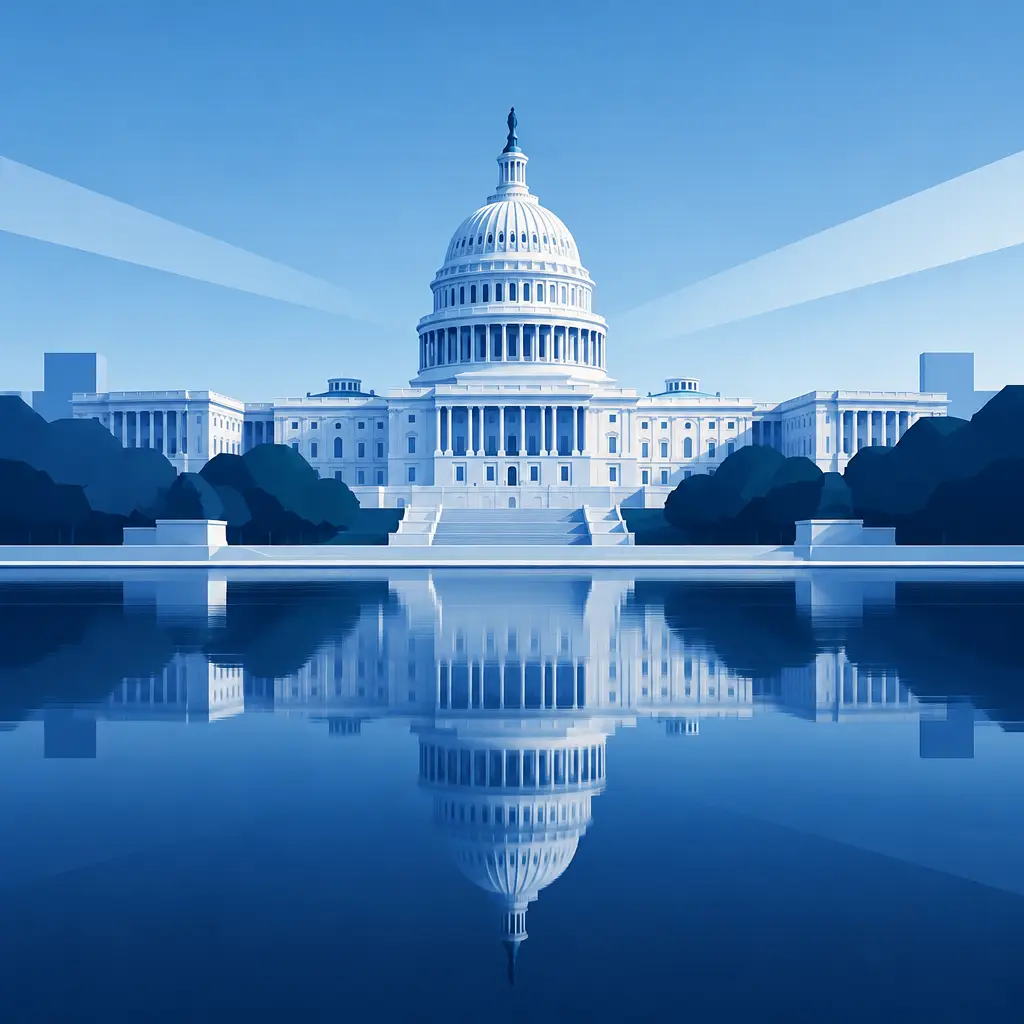
The Legislative Record That Could Be Left Behind
The past two years produced two significant legislative milestones under a Republican-led Congress. First, the GENIUS Act established a federal framework for stablecoins, providing the first statutory guardrails for a class of digital assets that many institutional finance teams had been holding or processing without clear legal footing. Second, the Clarity Act, a broader market structure bill intended to delineate which digital assets fall under SEC jurisdiction and which fall under CFTC jurisdiction, passed the House in 2025.
Why the Clarity Act stalled in the Senate
The Senate version of the Clarity Act ran into compounding obstacles. A dispute between banks and crypto firms over whether stablecoin issuers should be permitted to offer yield-bearing products created an early fault line. The bill's path was then further complicated by concerns among Democrats about the size and nature of the President's personal crypto holdings, which sources described as running to hundreds of millions of dollars tied to crypto ventures and family-linked entities. That combination proved difficult for enough Democratic senators to look past, and the bill ultimately did not advance.
The Blockchain Association, which has lobbied consistently for clear rules, stated after the Senate stall that it remained committed to getting legislation enacted regardless of which party controls Congress. Chief Policy Officer Lindsay Fraser put it plainly: "Control of Congress may change. The need for clear crypto rules won't." That commitment is on record, but commitment and committee chairmanship are very different things.
For context on how the industry's push for statutory clarity fits into a longer arc, see our earlier coverage on how the Blockchain Association has been pressing Congress for crypto tax clarity.
What a Democratic Congress Would Mean in Practice
Prediction markets, including Kalshi, placed a 64% probability on Democrats winning the Senate and a roughly 90% probability on winning the House at the time of reporting. Former New York Governor Andrew Cuomo, speaking on a call with reporters, suggested that even if those probabilities hold, nothing should be expected from the lame duck period before new lawmakers take office.
The more consequential question is what happens when new committee chairs take their seats. Four committees hold primary jurisdiction over the digital asset space: the Senate Banking Committee, the Senate Agriculture Committee, the House Agriculture Committee, and the House Financial Services Committee. Each would see its chairmanship change hands under a Democratic majority, and the individuals likely to fill those roles have well-documented track records on crypto.
Senate Banking Committee: Elizabeth Warren
If Democrats take the Senate, Senator Elizabeth Warren of Massachusetts is positioned to chair the Senate Banking Committee. Warren has used that platform previously to scrutinize cryptocurrency's role in sanctions evasion and terrorist financing, and she has called publicly for legislation that, in her framing, "dials back the corruption" rather than simply expanding the industry's operating parameters.
Ron Hammond, head of policy and advocacy at Wintermute, told The Block that Warren would likely deploy subpoena power aggressively and focus investigative energy on areas such as de novo bank charter applications from crypto-native firms. The practical ceiling on what she could do legislatively is real, since any bill would still require a presidential signature, but Hammond noted she could effectively block any helpful or positive legislative development for the industry from advancing through her committee.
Senate Agriculture Committee: Sherrod Brown
The Senate Agriculture Committee holds CFTC oversight and is therefore directly relevant to commodity-classified digital assets. Sherrod Brown, the former committee chair who is running in Ohio against crypto-friendly Republican Jon Husted, would be in line for that chairmanship again if he wins his seat. Brown was previously associated with the Digital Commodities Consumer Protection Act in 2022, a bill that became closely linked to the collapse of FTX and subsequently stalled. His return to the chair position would, in Hammond's assessment, put any crypto market structure legislation emerging from the House Agriculture Committee effectively on hold.
House Financial Services Committee: an unresolved contest
On the House side, current Republican Chair French Hill would be displaced if Democrats win the chamber. The expected frontrunner to reclaim the ranking Democrat position was Representative Maxine Waters, who had previously held the chair and had engaged substantively with the industry during GENIUS Act negotiations. However, Representatives Sean Casten and Bill Foster have both mounted challenges, with some Democrats signalling a desire for generational change given Waters' age.
Hammond's read is that Waters' approach would be largely consistent with her prior tenure, including some engagement with the industry alongside continued criticism. Foster, he said, would bring a heavier focus on oversight and crypto specifically. Casten, he suggested, would be even more aggressive on that front than either of the others.
The underlying point, regardless of which Democrat takes the gavel, is that the Clarity Act does not pass under any of the scenarios being discussed. A narrower, bipartisan bill remains theoretically possible, but it would need to reflect Democratic priorities, which makes Republican support and a presidential signature complicated to achieve simultaneously.
Accounting and Audit Implications for Firms
The scenario now taking shape, in which the US lacks a comprehensive digital asset market structure law for an extended additional period, has direct consequences for how accounting firms, auditors, and in-house finance teams approach digital assets on the balance sheet and in client portfolios.
Regulatory uncertainty is itself an accounting event
Under US GAAP, indefinite-lived intangible asset treatment for digital assets under ASC 350 requires impairment testing when fair value falls below carrying value. The ASU 2023-08 update, which introduced fair value accounting for certain crypto assets for fiscal years beginning after 15 December 2024, applies to entities that hold assets meeting its criteria regardless of what Congress does or does not pass. What a prolonged absence of market structure legislation does affect is the risk premium embedded in fair value estimates and the disclosure language around regulatory uncertainty that auditors and preparers need to calibrate.
Firms with significant digital asset exposure in client accounts should expect that audit committees will press harder on the adequacy of going-concern and risk disclosures if the legislative picture deteriorates. The language around "pending legislation" or "anticipated regulatory clarity" that appeared in many 2025 disclosures will need to be revisited if the anticipated legislation is no longer anticipated.
Compliance programme design in the absence of statute
One of the central practical benefits the Clarity Act was expected to deliver was a clearer delineation between SEC and CFTC jurisdiction, removing a source of chronic uncertainty about which regulatory framework applied to a given token or transaction type. Without that statutory line, firms operating crypto desks or advising clients with digital asset holdings continue to face the risk that an asset classified one way today could be reclassified by enforcement action or court ruling.
That ongoing ambiguity has direct implications for how digital asset accounting software is configured. Classification errors at the point of initial recognition, whether an asset is treated as a security or a commodity, flow into every downstream accounting and tax calculation. Firms that have deferred compliance programme investment pending legislative clarity need to treat that deferral itself as a risk rather than a reasonable wait. A Democratic-led oversight agenda centred on investigations and hearings may produce agency guidance or enforcement precedents that function as de facto regulation, but those are harder to operationalise in advance than a statute.
The risk of proceeding without statutory clarity is not hypothetical. As we covered in detail, JPMorgan has noted that regulatory actions alone, without a market structure law, leave lasting risk for digital asset firms.
Tax reporting exposure in a heightened oversight environment
A Democratic-led Senate Banking Committee with subpoena power and an appetite for investigation creates a secondary compliance risk: increased scrutiny of how firms and high-net-worth individuals have been reporting digital asset transactions. Warren's stated concerns about sanctions evasion and illicit finance suggest that investigations, if they come, will not be limited to industry participants. Service providers, including accounting firms that sign off on digital asset disclosures, could find themselves subject to document requests.
The practical upshot is that firms should treat this moment as an opportunity to audit their own audit trails. Digital asset accounting software configurations, transaction classification methodologies, and the documentation underlying cost-basis calculations should all be reviewable on short notice. That is not a counsel-of-fear response to political developments. It is baseline practice for any compliance-mature firm operating in a space where enforcement attention is likely to increase regardless of which party controls Congress.

What to Watch Between Now and January
Several near-term indicators will shape the planning horizon for digital asset firms and their advisers. The first is the election result itself, including not just which party controls each chamber but the margin of control. A narrow Democratic majority constrains what any committee chair can do unilaterally; a wider majority gives committee leadership more running room.
The second is the lame duck period. Senator Alsobrooks, who was deeply involved in Clarity Act negotiations and who described it as "absolutely not" a Democratic priority under new leadership, also acknowledged that passage in the lame duck window was not impossible. A narrow window exists if current Republican leadership decides to move quickly before January, though the political conditions that derailed the bill in the first place have not changed.
The third is committee appointment announcements. The specific individuals who chair the four key committees will determine how aggressively oversight is pursued, what the targets of that oversight are, and whether any narrower bipartisan legislation has any room to move. Firms should monitor those appointments closely and map them against their own regulatory exposure.
The fourth, relevant specifically for firms using or evaluating digital asset accounting software, is whether increased congressional scrutiny accelerates IRS or FinCEN guidance on reporting obligations. Heightened political attention to the space historically correlates with regulatory agencies moving faster on guidance, and that guidance, when it arrives, requires rapid system updates to remain compliant.
Source: The Block
Frequently Asked Questions
Will the Clarity Act pass if Democrats take Congress?
Based on current reporting, it is very unlikely. Senator Alsobrooks, a Democrat who was central to the Clarity Act negotiations, said it is "absolutely not" a Democratic priority. Passage during the lame duck period remains a remote possibility, but the political conditions that caused the bill to stall have not been resolved.
How does a shift from legislation to oversight affect digital asset accounting?
Without statutory clarity on asset classification, firms continue to rely on a patchwork of SEC and CFTC enforcement precedents and agency guidance. That means cost-basis methodology, asset classification at initial recognition, and disclosure language all carry higher revision risk. Accounting teams should treat their existing classification frameworks as provisional and ensure they are documented well enough to survive external scrutiny.
What does increased congressional oversight mean for AML compliance at crypto-active firms?
A Senate Banking Committee focused on investigations is likely to scrutinise sanctions exposure and transaction monitoring practices. Firms should ensure their AML programmes are current, that suspicious activity reporting workflows are properly documented, and that any digital asset accounting software integrations with transaction monitoring tools are functioning correctly and generating complete audit trails.
Does ASU 2023-08 fair value accounting for crypto change based on congressional developments?
No. ASU 2023-08 is an FASB standard and applies independently of what Congress does. However, fair value measurements require assessment of market participant assumptions, and regulatory uncertainty is a legitimate input into risk-adjusted valuations. If the legislative environment deteriorates, the disclosure requirements around that uncertainty become more demanding, not less.
Should firms delay investment in crypto bookkeeping software while the regulatory picture is unclear?
Deferring investment until there is statutory clarity is itself a risk position. Enforcement-driven precedents and agency guidance can arrive faster than legislation, and firms that have not automated their transaction classification and reporting workflows are exposed to retrospective errors that are both costly and time-consuming to correct. The regulatory environment being uncertain is a reason to invest in robust systems sooner, not later.