
Crypto Accounting Software: Inventory or Intangible Asset?
How a business classifies its crypto holdings shapes every journal entry, every balance sheet line, and every audit conversation that follows. Crypto accounting software needs to handle both possibilities, because the answer is not universal. Under current global accounting frameworks, some crypto assets qualify as inventory, while others sit firmly in the intangible asset category. Getting the classification wrong from day one creates misstatements that compound across reporting periods. This article works through the accounting logic behind each classification, the measurement rules that attach to each, and the practical configuration choices that follow inside your digital asset accounting software.
Why Classification Matters More Than Most Firms Expect
Asset classification in accounting is never cosmetic. The category you assign to a digital asset determines the measurement basis, the impairment test, the income statement treatment on disposal, and the disclosures you owe stakeholders. For crypto, these stakes are amplified because prices can move sharply within a single reporting period. A holding that was immaterial in January can become a material line item by March, and your accounting treatment had better be consistent across both points.
Impact on Cost Basis Tracking
The classification decision also affects how your crypto bookkeeping software captures cost basis. If an asset is treated as inventory, the software must track units and apply a cost flow assumption such as FIFO, weighted average, or specific identification. If the asset is an intangible, the software must apply the intangible asset rules under whichever framework you are reporting under, which means a different impairment logic entirely under US GAAP compared with IFRS. Finance teams that import a generic ledger template without resolving this question first will find themselves rebuilding their chart of accounts mid-year.
The stakes are equally high for accounting firms advising clients. A misclassified holding in a client's books is an audit finding waiting to happen. Firms that use enterprise crypto accounting software with configurable asset-type flags can catch classification errors before the trial balance is finalised, rather than during a late-stage review.
Crypto as an Intangible Asset Under IFRS
IAS 38 is the default landing place for most crypto holdings under IFRS. The standard applies to identifiable non-monetary assets without physical substance, and most cryptocurrencies satisfy that description. They are separable, they can be sold independently, and they do not represent a contractual right to receive cash in the way a financial instrument does. The IFRS Interpretations Committee confirmed this position, clarifying that holdings such as Bitcoin and Ether held by entities that do not hold them for sale in the ordinary course of business fall under IAS 38.
Cost Model vs Revaluation Model
Under IAS 38, the default measurement model after initial recognition is the cost model. That means the asset sits at cost less any accumulated impairment losses. Critically, impairment under IAS 38 is a one-way street under the cost model: you write down but you cannot write back up through profit or loss. However, entities may elect the revaluation model if an active market exists for the asset. Under the revaluation model, the asset is carried at fair value at the revaluation date, with gains going to other comprehensive income and only excess losses hitting the income statement. The existence of active crypto markets makes the revaluation model available for many tokens, but it requires consistent application and robust price sourcing.
| Feature | Cost Model (IAS 38) | Revaluation Model (IAS 38) |
|---|---|---|
| Initial measurement | Cost | Cost |
| Subsequent measurement | Cost less impairment | Fair value at revaluation date |
| Upward revaluation | Not permitted | Recognised in OCI |
| Impairment reversal | Not permitted through P&L | Limited reversal via OCI |
| Active market required | No | Yes |
When Crypto Qualifies as Inventory
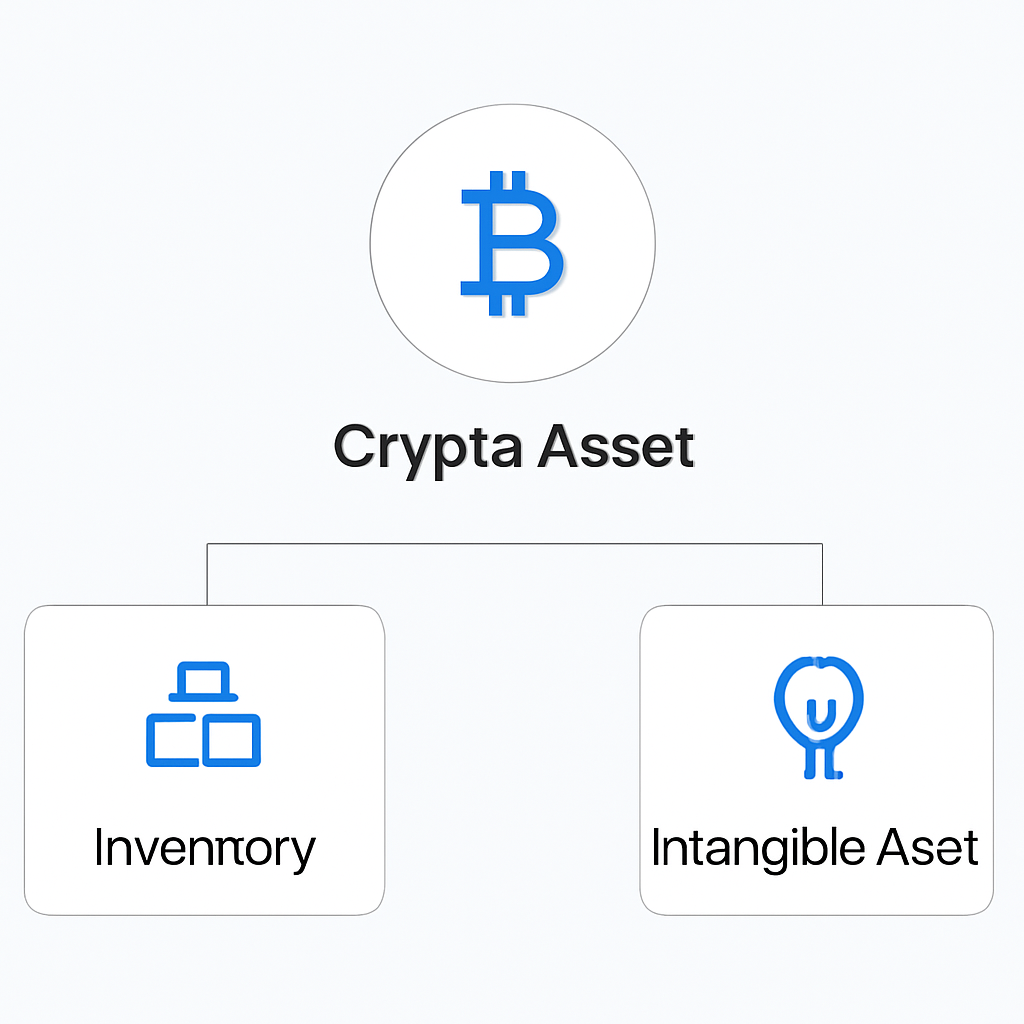
The inventory classification applies when an entity holds crypto for sale in the ordinary course of business. IAS 2 is the relevant standard under IFRS, and ASC 330 applies under US GAAP. Commodity brokers and dealers who routinely buy and sell crypto as their primary activity are the clearest example. A crypto exchange that holds tokens to facilitate trading, or a market-maker whose business model depends on inventory turnover, will generally meet the IAS 2 criteria.
Broker-Dealer Exception for Fair Value
Inventory is measured at the lower of cost and net realisable value for most entities. However, IAS 2 contains a broker-dealer exception: commodity broker-traders may measure inventory at fair value less costs to sell, with changes recognised directly in profit or loss. This exception is significant for crypto firms because it aligns accounting treatment with the economic reality of a business that is continuously buying and selling assets at market prices. Under US GAAP, ASC 820 fair value guidance applies to broker-dealers carrying crypto inventory, and ASU 2023-08 now requires most other entities to measure crypto assets at fair value with changes recognised in net income, which effectively narrows the gap between GAAP and IFRS for many US-reporting entities.
The practical implication for digital asset accounting software is that inventory accounting requires a different cost flow engine. The software must track individual lots, apply cost flow assumptions, and flag units that fall below net realisable value. This is structurally different from the impairment-only logic used for intangible assets.
US GAAP: A Shifting Landscape After ASU 2023-08
US GAAP historically treated most crypto assets as indefinite-lived intangible assets under ASC 350, which meant cost less impairment with no ability to reverse write-downs through earnings. That treatment drew criticism because it produced balance sheet values that could significantly understate the economic value of holdings in a rising market. The FASB responded with ASU 2023-08, which requires entities to measure crypto assets that meet the standard's scope criteria at fair value each reporting period, with changes recognised in net income.
Scope and Legacy Treatment
ASU 2023-08 does not apply to all digital assets. Wrapped tokens, NFTs, and assets that represent ownership interests in other entities fall outside its scope. For those assets, the legacy intangible asset or other applicable treatment continues. This means a single entity may now apply two or three different measurement approaches across its crypto portfolio, depending on what it holds. Best crypto accounting software must be able to apply asset-level measurement flags rather than a single portfolio-wide rule.
| Standard | Framework | Measurement Basis | P&L Impact |
|---|---|---|---|
| IAS 38 (cost model) | IFRS | Cost less impairment | Impairment losses only |
| IAS 38 (revaluation model) | IFRS | Fair value | Losses through P&L; gains in OCI |
| IAS 2 (broker-dealer exception) | IFRS | Fair value less costs to sell | Full fair value changes in P&L |
| ASC 350 (pre-ASU 2023-08) | US GAAP | Cost less impairment | Impairment losses only; no reversal |
| ASU 2023-08 | US GAAP | Fair value | Full fair value changes in net income |
| ASC 330 (inventory) | US GAAP | Lower of cost or NRV | Write-downs only for most entities |
How Classification Shapes Your Crypto Sub-Ledger Configuration
Once you have resolved the accounting policy question, the configuration work inside your software begins. A crypto sub-ledger for digital asset reconciliation must be set up to reflect the measurement basis at the asset level, not just at the entity level. A treasury team that holds Bitcoin as a long-term reserve asset under IAS 38, while also holding a pool of stablecoins for operational payments that might qualify as cash equivalents, needs separate ledger treatments running in parallel.
Lot-Level Tracking for Inventory
For inventory holdings, the sub-ledger must support lot-level tracking so that cost flow assumptions are applied correctly and auditable. For intangible assets under the cost model, the ledger needs an impairment flag that locks the carrying value from rising above cost. For fair-value-measured assets, the system must pull in a defensible price source at each measurement date and record the movement to the correct income or equity account depending on the applicable standard. These are not configuration choices you can retrofit easily. Establishing the right account structure at implementation is considerably cheaper than correcting it after twelve months of transactions.
Audit Readiness and the Classification Decision
Auditors reviewing a crypto-holding entity will scrutinise the accounting policy note first. They want to see that management has made a deliberate, documented classification decision and applied it consistently. Inconsistency between periods, or between similar assets within the same portfolio, will trigger a qualification risk. Accounting firms acting as auditors should ask clients for a written accounting policy that addresses the classification criteria, the measurement model elected, the price sourcing methodology, and the cost flow assumption used for any inventory holdings.
Consistency Across Asset Types
A crypto accountant reviewing a client file for the first time should also check whether the entity has applied a single blanket treatment across all digital assets without considering the nature of each holding. A mining company, a payment processor, and a corporate treasury holding crypto as a reserve asset may each need a different classification for their holdings, even though all three technically own the same underlying token. The entity's business model and intent at acquisition are decisive factors, and both must be documented contemporaneously rather than reconstructed at year-end.
Illustrative Scenario
This scenario is illustrative. It does not describe a real person or client, and the figures are examples only.
To illustrate how this applies in practice, consider the following scenario:
Priya is the CFO of a mid-sized fintech firm based in Singapore that reports under IFRS. The company holds two types of digital assets: a reserve position in a major cryptocurrency that it intends to hold for the medium term as a treasury asset, and a rotating pool of tokens that its trading desk buys and sells daily to generate spread income. When Priya's team first implemented their enterprise crypto accounting software, they initially applied a single IAS 38 cost-model treatment to the entire portfolio because it appeared to be the conservative choice.
During the year-end audit, the auditors flagged that the trading desk's holdings should be classified as inventory under IAS 2, with the broker-dealer fair-value exception applied, given that trading is the ordinary course of business for that desk. The reserve holdings remained correctly under IAS 38. Priya's team then reconfigured their crypto sub-ledger to apply separate measurement tracks per asset pool, with lot-level tracking on the inventory side and an impairment-only model on the treasury side. CryptaCount's asset-type flags and dual-model ledger structure allowed the team to rebuild the prior-period entries cleanly and provide the auditors with a fully reconciled schedule within two days, avoiding a qualified opinion.

Frequently Asked Questions
Is Bitcoin always classified as an intangible asset?
Not always. For most entities holding Bitcoin as a treasury or investment asset, IAS 38 or ASC 350 applies and the asset is treated as an intangible. However, if an entity holds Bitcoin for sale in the ordinary course of business, such as a crypto exchange or market-maker, it may qualify as inventory under IAS 2 or ASC 330. The entity's business model and intent at acquisition are the determining factors.
Can a company apply the IAS 38 revaluation model to its crypto holdings?
Yes, provided an active market exists for the asset. Most major cryptocurrencies traded on principal exchanges are likely to satisfy this condition. Under the revaluation model, the asset is carried at fair value at the revaluation date, with upward revaluations recognised in other comprehensive income rather than profit or loss. Consistent application and a documented price sourcing methodology are required.
What did ASU 2023-08 change for US GAAP reporters?
ASU 2023-08 replaced the indefinite-lived intangible asset treatment for in-scope crypto assets under ASC 350 with a fair value measurement model. Entities must now recognise fair value changes in net income each reporting period. Assets outside the standard's scope, including NFTs, wrapped tokens, and assets representing ownership interests, continue under the prior treatment.
How does crypto accounting software handle two different measurement models at once?
Good digital asset accounting software applies measurement rules at the asset or asset-pool level rather than entity-wide. This means each holding can carry its own classification flag, cost flow method, and valuation logic. A crypto sub-ledger that supports asset-level configuration allows finance teams to run inventory accounting and intangible asset accounting simultaneously within one system, with each producing the correct journal entries for consolidation.
What is the broker-dealer exception under IAS 2?
IAS 2 allows commodity broker-traders to measure inventory at fair value less costs to sell, with movements recognised directly in profit or loss. This exception bypasses the standard lower-of-cost-or-NRV rule. It is available to crypto entities whose primary business involves buying and selling digital assets as principal, and it aligns accounting outcomes more closely with the economic reality of active trading operations.
Which cost flow method should a crypto accountant use for inventory holdings?
IAS 2 permits FIFO or weighted average cost but prohibits LIFO. US GAAP under ASC 330 permits FIFO, LIFO, and weighted average, though LIFO is rarely used for crypto in practice. Specific identification is appropriate where individual lots can be tracked precisely, which most modern crypto bookkeeping software supports. The chosen method must be applied consistently and disclosed in the accounting policy note.
Does the classification change how disposal gains are recognised?
Yes. Disposal of an inventory asset generates trading revenue or cost of sales depending on the entity's income statement format. Disposal of an intangible asset under the cost model generates a gain or loss on disposal measured against the carrying amount. Under the IAS 38 revaluation model, any revaluation surplus remaining in equity at disposal is transferred directly to retained earnings rather than recycled through profit or loss. These differences affect both the income statement presentation and the tax computation.
What disclosures are required for crypto holdings classified as intangible assets?
IAS 38 requires disclosure of the measurement model elected, the gross carrying amount and accumulated impairment at the start and end of the period, and a reconciliation of movements. If the revaluation model is used, additional disclosures cover the revaluation date, the method used to determine fair value, and the carrying amount that would have been recognised under the cost model. Entities should also consider whether their crypto holdings represent a material risk that requires description in the financial risk note.
Source: CryptaCount