
AML Compliance Risks: Mixers and Privacy Wallets in Crypto Screening
Most blockchains are transparent by design. Every transaction is visible, traceable, and permanent. That openness is exactly why criminals have turned to mixers and privacy wallets: two technologies that can sever the on-chain trail and quietly undermine the compliance controls that accounting firms, auditors, and CFOs rely on. Understanding how these tools work, and what your systems need to detect them, is now a baseline AML requirement rather than an advanced specialisation.

What Mixers and Privacy Wallets Actually Do
These two categories are often mentioned together, but they operate differently and present distinct screening challenges.
Mixers: pooling and re-routing funds
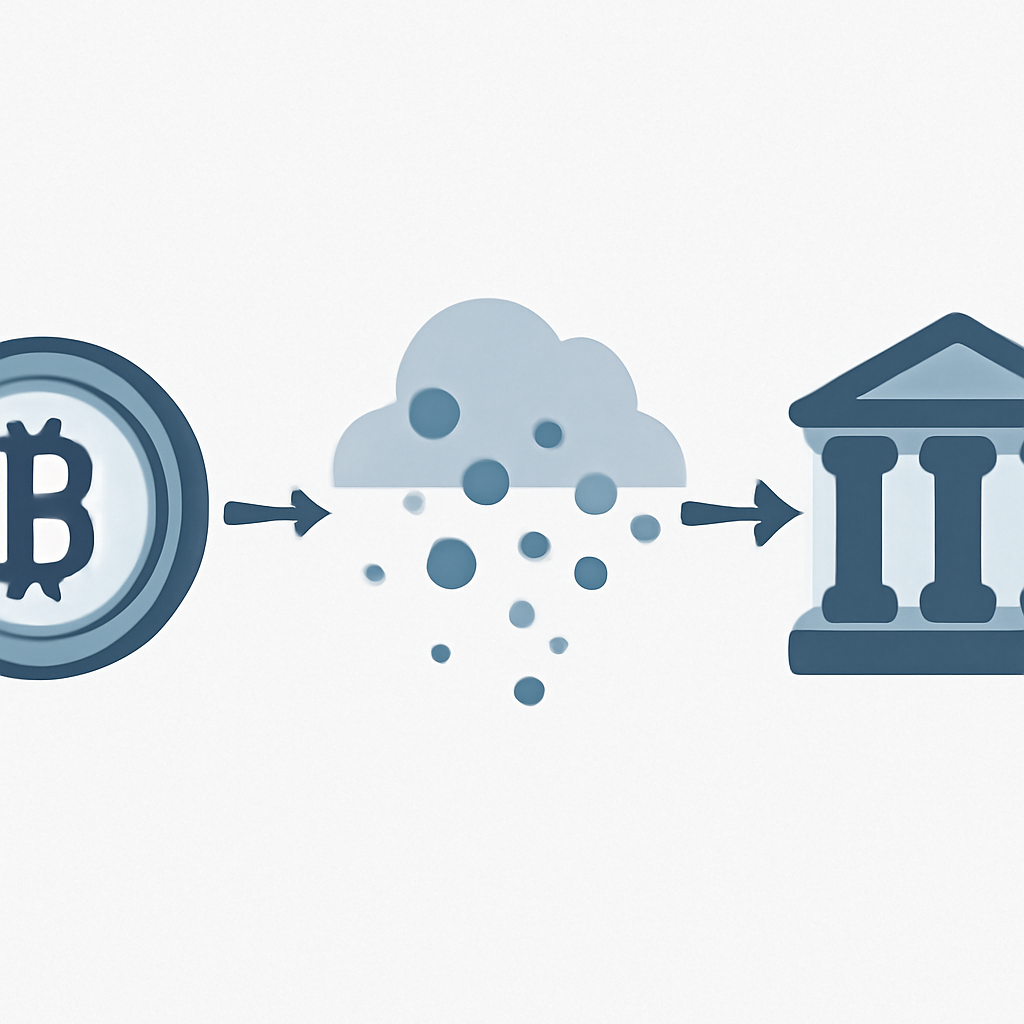
A mixer is a service that pools a user's cryptoassets with those of other participants and then redistributes equivalent amounts to a destination address specified by each user. The pooling step breaks the direct on-chain link between the sending address and the receiving address. Anyone tracing the funds hits a wall at the mixer's pool. The output looks clean; the illicit origin is buried inside a tangle of legitimate-looking transactions.
Privacy wallets: obfuscation built into the software
Privacy wallets are typically self-custodial, open-source applications that have obfuscation logic baked directly into their architecture. They mask the identities of senders and recipients at the protocol or wallet level, without the need for a centralised mixing service. Because there is no single intermediary, they can be harder to identify and block than a known mixer address. Law enforcement and compliance teams face the same problem: the flow of funds becomes difficult or impossible to reconstruct automatically.
Neither technology is inherently criminal. Both have legitimate privacy use cases. The compliance problem arises from the fact that bad actors exploit them systematically, and most automated screening systems are not built to handle what comes next.
Two Core Laundering Patterns Firms Must Recognise
The mechanics of obfuscation-based laundering tend to follow one of two broad patterns. Knowing both is essential for risk calibration, whether you are running client due diligence at an accounting firm or reviewing transaction records as part of an audit.
Pattern one: obfuscate before depositing at an exchange
A criminal routes illicit funds through a mixer or privacy wallet before sending them to a regulated exchange or a business's treasury address. By the time the funds arrive, the connection to the original theft, fraud, or sanctioned activity has been severed. The receiving institution's compliance system sees a wallet with no direct exposure to a known bad actor. A hop-based screening approach, one that only checks the immediately preceding address, is especially vulnerable here. Add enough intermediate steps and the original source becomes invisible to shallow-depth analytics.
For firms using any kind of crypto accounting software to record client inflows, this matters directly. A transaction recorded as clean at point of receipt may carry embedded exposure that only a deeper tracing capability would surface. That has audit implications and potential regulatory liability under AML frameworks in both the US and EU.
Pattern two: obfuscate before conducting illicit activity
The second pattern runs in the opposite direction. A criminal withdraws funds from a legitimate exchange and routes them through a mixer or privacy wallet before spending them on dark-web marketplaces or other illicit services. The goal here is to break the link between their verified identity at the exchange and the downstream activity. Because a licensed exchange typically holds KYC data, that link is exactly what law enforcement would follow. A mixer inserted between the exchange and the illicit purchase removes that forensic thread.
For compliance teams, this pattern underlines why outbound transaction monitoring matters as much as inbound screening. If a client's wallet is regularly sending funds toward known mixer addresses, that behavioural signal is a red flag regardless of how the funds originally arrived.
Why Standard Compliance Systems Fall Short
Automated blockchain analytics tools cannot typically trace through a mixer or privacy wallet on their own. The obfuscation is, by design, the limit of automated reconstruction. What good tooling can do, however, is flag that a transaction has touched one of these services. That flag, rather than a clean or blocked binary, is where human compliance judgment has to take over.
The hop-based compliance gap
A hop-based approach to risk assessment evaluates only how many steps separate a wallet from a known bad actor or illicit service. It is computationally efficient, but it is exactly the vulnerability that sophisticated launderers exploit. By inserting enough hops, including mixer passes, a criminal can push the risk score below an automated alert threshold. Firms relying exclusively on hop-depth logic without holistic tracing are exposed.
What the detection signal actually looks like
The realistic compliance signal is an interaction flag, not a full trace. A wallet has sent funds to or received funds from a known mixer address, a privacy wallet cluster, or a service associated with obfuscation activity. At that point, the firm needs a documented process for deciding what to do next. That decision should factor in the size of the transaction, the frequency with which the client has interacted with high-risk services, the client's stated business purpose, and the firm's own risk appetite as documented in its AML policy.
Firms that have not updated their AML procedures to include explicit handling of mixer and privacy wallet exposure are likely non-compliant with both FinCEN guidance in the US and the AML obligations that apply to crypto-asset service providers under EU law. Reviewing OFAC SDN cryptocurrency address screening obligations alongside mixer exposure policies is a logical pairing, since both relate to the completeness of your transaction screening framework.
Implications for Crypto Accounting and Audit Workflows
Accounting firms and auditors working with digital asset clients face a specific version of this problem. When a client's digital asset accounting software records a transaction as settled and legitimate, that record reflects the data fed into it. If the underlying blockchain analytics layer did not flag mixer exposure at the time of transaction, the accounting record will not reflect the risk. That gap can become material in an audit context, particularly if the client is subsequently investigated for AML violations or if the funds are linked to a sanctioned party.
Due diligence questions to ask now
Any firm providing crypto bookkeeping software integration or advisory services should be asking clients these questions as part of onboarding and periodic review:
- Does your blockchain analytics provider identify exposure to mixers and privacy wallets, not just direct sanctions matches?
- What is your documented policy for transactions that carry a mixer interaction flag?
- Does your screening apply holistic tracing rather than only immediate-hop logic?
- Are outbound transactions monitored as well as inbound flows?
- When was your AML risk assessment last updated to reflect privacy coin and obfuscation technology risks?
These questions align directly with the kind of data quality and methodology scrutiny covered in our piece on blockchain analytics data quality due diligence. The underlying principle is the same: the output of any digital asset accounting software is only as reliable as the compliance data flowing into it.
Regulatory Context in the US and EU
US: FinCEN enforcement posture
US regulators have taken an increasingly firm position on mixer exposure. FinCEN has designated certain mixing services as primary money laundering concerns under the Bank Secrecy Act. Businesses that knowingly process transactions with mixer exposure, or that fail to implement controls capable of detecting it, face BSA enforcement risk. The regulatory standard is not whether a firm detected every illicit transaction; it is whether the firm had adequate procedures in place to identify and respond to the exposure.
EU: AMLD6 and MiCA obligations
In the EU, the sixth Anti-Money Laundering Directive and the AML obligations embedded in MiCA create a comparable standard for crypto-asset service providers. CASPs are required to conduct transaction monitoring and apply enhanced due diligence to high-risk situations. A transaction routed through a mixer or privacy wallet, where the counterparty's identity cannot be established, is a textbook high-risk situation under that framework. The MiCA transitional period closed on 1 July 2026, meaning firms that previously relied on national transitional provisions no longer have that buffer. Compliance obligations are now fully live across the EU.
Practical Steps for Compliance Teams
The source material is clear that full automated tracing through a mixer is not currently achievable. That does not mean firms are helpless. It means the compliance architecture needs to be built around the detection signal that is available, namely the interaction flag, and the human process triggered by it.
- Confirm that your blockchain analytics provider flags mixer and privacy wallet interactions explicitly, not just sanctions hits or direct darknet exposure.
- Document a written procedure for how mixer interaction flags are escalated, reviewed, and resolved. This is the record a regulator will ask for first.
- Apply transaction size and frequency weighting to mixer exposure. A single small interaction may warrant a lower response than repeated large transfers toward obfuscation services.
- Include outbound monitoring in your transaction surveillance scope, not just inbound screening at onboarding.
- Review your AML risk assessment at least annually and ensure obfuscation technologies, including privacy coins and advanced mixer variants, are explicitly addressed.
For broader context on how illicit finance networks use layered obfuscation strategies, our analysis of the Huione Group illicit marketplace and USDH stablecoin AML risk shows how these patterns operate at scale across interconnected criminal ecosystems.
Source: Elliptic
FAQ
FAQ
Are mixers and privacy wallets illegal under US or EU law?
The technologies themselves are not uniformly prohibited, but their use in laundering funds is illegal, and certain mixing services have been formally designated as money laundering concerns by FinCEN under the Bank Secrecy Act. In the EU, CASPs are required to apply enhanced due diligence to transactions involving obfuscation tools, and processing such transactions without adequate controls can constitute an AML violation regardless of whether the underlying technology is legal.
Can blockchain analytics tools trace through a mixer or privacy wallet?
Not reliably on an automated basis. The obfuscation is designed specifically to break automated tracing. What analytics tools can do is identify that a transaction has interacted with a known mixer or privacy wallet service. That interaction flag is the trigger for human review and a documented risk decision, not a definitive pass or fail outcome.
What does a hop-based compliance approach miss?
A hop-based approach evaluates risk based on how many transaction steps separate a wallet from a known bad actor. Criminals can exploit this by inserting enough intermediate hops, including mixer passes, to push the flagged origin beyond the system's scanning depth. Holistic tracing that follows the full transaction graph, rather than stopping at a set number of hops, is more robust but also more computationally demanding.
How should an accounting firm respond when a client's transaction carries a mixer interaction flag?
The firm should have a documented escalation procedure in its AML policy before that situation arises. The response typically involves reviewing the transaction size, the frequency of the client's interactions with high-risk services, the client's stated business purpose, and the firm's risk appetite. Depending on those factors, the appropriate outcome may be enhanced due diligence, a suspicious activity report, or rejection of the transaction.
Does the MiCA transitional period closing in July 2026 affect mixer and privacy wallet obligations?
Yes. From 1 July 2026, CASPs that previously operated under national transitional provisions are fully subject to MiCA's AML and transaction monitoring requirements across the EU. That includes obligations to apply enhanced due diligence to high-risk transactions, which regulators would expect to cover transactions with mixer or privacy wallet exposure where the counterparty cannot be identified.