
Crypto Audit Software: Accounting and Audit Requirements in the Netherlands
Crypto assets have moved firmly into the mainstream of Dutch financial reporting, and accounting firms can no longer treat them as an occasional curiosity. Clients ranging from sole traders and SMEs to investment funds now hold digital assets, stake tokens, and interact with decentralised protocols. Each of those activities creates accounting entries, disclosure obligations, and, where applicable, audit evidence requirements that must be satisfied under Dutch GAAP, IFRS as adopted in the EU, and the evolving MiCA regulatory framework. For firms without the right processes in place, crypto engagements carry real risk: misclassified assets, incomplete transaction records, and gaps in audit trails can expose both the client and the firm. Purpose-built crypto audit software addresses those risks directly, giving auditors and accountants a structured environment to ingest, reconcile, and report on digital asset holdings in a way that stands up to scrutiny.

How the Netherlands Regulates Crypto Asset Accounting
The Netherlands sits within the EU regulatory perimeter, which means Dutch firms must navigate both domestic Dutch GAAP rules issued by the Dutch Accounting Standards Board (RJ) and EU-level standards as they develop. For entities preparing financial statements under IFRS, the absence of a dedicated IFRS standard for crypto assets has historically forced preparers to apply either IAS 38 (intangible assets) or, in limited cases, IAS 2 (inventories), depending on the nature of the holding and the entity's business model. The IASB has acknowledged this gap and has been working toward clearer guidance, but Dutch preparers must currently use judgement and disclose that judgement transparently.
Dutch GAAP vs IFRS Treatment
Under Dutch GAAP, the RJ has provided guidance aligning broadly with the intangible asset model for most crypto holdings, with fair value measurement available where an active market exists. This creates a genuine complexity for crypto accountants: the same token can have a different accounting treatment depending on the entity type, the purpose for which it is held, and whether the entity is an investment fund or an operating company. A crypto accountant working across multiple client types in the Netherlands must therefore maintain a clear classification framework for every engagement, not a single universal rule.
The table below summarises the primary accounting treatments applicable to common crypto asset types under Dutch GAAP and IFRS as adopted in the EU.
Summary Table of Accounting Treatments
| Asset Type | Likely Standard (IFRS) | Likely Standard (Dutch GAAP) | Measurement Basis |
|---|---|---|---|
| Bitcoin, Ether (held for investment) | IAS 38 (intangible asset) | RJ 620 (intangible asset) | Cost or revaluation (if active market) |
| Crypto held as inventory (trader/broker) | IAS 2 (inventories) | RJ 220 (inventories) | Lower of cost or net realisable value |
| Stablecoins (redeemable, fiat-backed) | IFRS 9 (financial asset) | RJ 290 (financial instrument) | Amortised cost or fair value |
| Staking rewards received | IAS 38 / judgement required | RJ 272 / judgement required | Fair value at date of receipt |
Crypto Audit Software: What Dutch Auditors Actually Need
When an auditor picks up a crypto engagement in the Netherlands, the fundamental audit objectives do not change. Existence, completeness, valuation, rights and obligations, and presentation still drive the work. What changes is the evidence. On-chain transactions recorded on a public blockchain provide a permanent, immutable record, but reading that record, reconciling it to a client's books, and tracing it through to financial statement line items requires specialised tooling that general-purpose audit software simply does not provide.
Role of Crypto Audit Software
Crypto audit software fills that gap by connecting directly to blockchain data sources, centralised exchange APIs, and custody providers. It reconstructs a complete transaction history for each wallet or account, calculates cost basis using configurable methods such as FIFO, LIFO, or weighted average, and flags anomalies that warrant auditor attention. For Dutch auditors working under the NBA's (Nederlandse Beroepsorganisatie van Accountants) standards, maintaining a documented audit trail from source data through to financial statement amounts is not optional. A platform that logs every data pull, every reconciliation step, and every override provides the working-paper equivalent that a paper-based process cannot reliably produce.
Independent Reperformance for Auditors
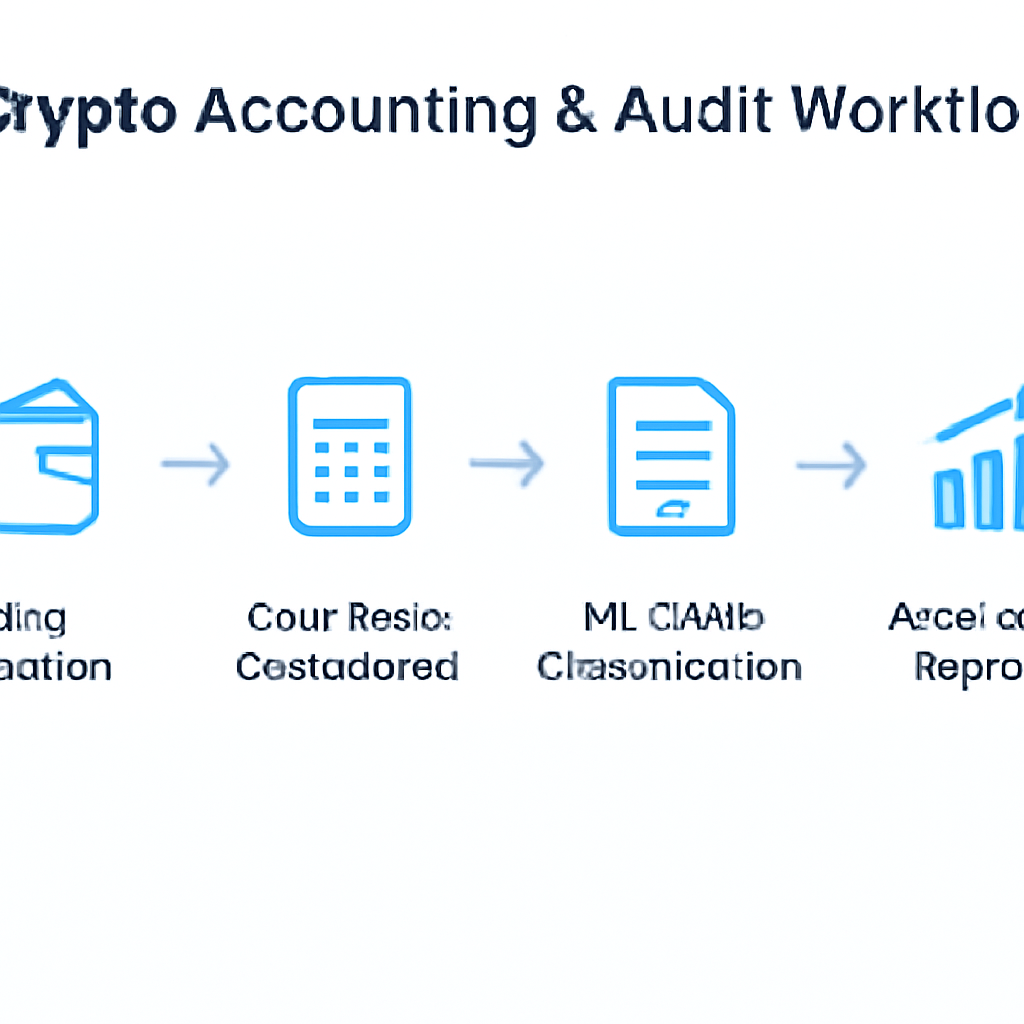
For crypto accounting for auditors specifically, the ability to produce independent calculations, rather than simply accepting client-prepared schedules, is critical. An auditor who relies entirely on the client's own crypto accounting output without running independent checks is leaving a significant gap in their procedure. The right software allows an auditor to re-perform cost basis calculations independently, compare results to the client's figures, and document any differences.
Crypto Accounting for Accounting Firms: Managing Multiple Clients
For accounting firms in the Netherlands handling crypto across a portfolio of clients, the workflow challenge is just as significant as the technical accounting one. Each client may use different exchanges, different wallets, different staking protocols, and different custody arrangements. Without a centralised platform, the firm's crypto accountant spends disproportionate time on data gathering and reconciliation rather than on the advisory and compliance work that generates value.
Multi-Client Workflow Challenges
Crypto accounting for accounting firms benefits most from multi-entity, multi-client architectures where client data is segregated but the firm's methodology, cost basis rules, and reporting templates are applied consistently. This consistency matters for quality control. If two accountants in the same firm classify the same asset type differently across two client files, the firm has a practice management problem as well as a technical one. Standardised workflows enforced by the software reduce that risk.
Client Education and Reporting
Dutch accounting firms also face a client education challenge. Many SME clients holding crypto do not understand the difference between a disposal and a transfer, or why staking rewards create a taxable event at receipt. The firm's role increasingly includes producing clear, client-facing summaries alongside the formal financial statements, and good crypto accounting for accountants means having tools that can generate both the technical output and the plain-language summary from the same underlying data.
Our crypto compliance reporting capability is designed precisely for this environment, supporting firms that need to move between client files and regulatory frameworks without rebuilding their process each time.
Crypto Fund Accounting Software and the Dutch Investment Fund Sector
The Netherlands is home to a significant number of investment funds, including crypto-native funds and traditional funds that have begun allocating to digital assets. These entities face accounting requirements that go beyond the standard corporate reporting framework. Funds must produce accurate NAV calculations, allocate gains and losses across investors, handle subscriptions and redemptions, and comply with AIFMD reporting where applicable. None of those tasks are straightforward when the underlying portfolio includes a mix of liquid tokens, staking positions, locked DeFi positions, and NFTs.
Fund-Specific Accounting Needs
Crypto fund accounting software addresses the fund-specific layer on top of the standard accounting treatment. It needs to handle the continuous repricing of assets for NAV purposes, model the tax lot implications of investor-level transactions, and produce the fund administrator reports that institutional investors and regulators expect. For Dutch fund managers subject to AFM oversight, having a documented, auditable accounting process for digital assets is increasingly a condition of continued operation rather than a best-practice aspiration.
Key Challenges and Software Requirements
| Fund Type | Key Accounting Challenge | Relevant Regulation | Software Requirement |
|---|---|---|---|
| Crypto-native investment fund | Continuous NAV calculation across volatile assets | AIFMD, AFM rules | Real-time pricing feeds, automated NAV engine |
| Traditional fund with crypto allocation | Segregated cost basis for digital assets within wider portfolio | IFRS 9, IAS 38 | Sub-ledger with asset-class segmentation |
| DeFi-focused fund | Accounting for liquidity positions, yield, and impermanent loss | Judgement under IFRS | Protocol-level transaction parsing |
MiCA and Its Impact on Dutch Crypto Accounting Obligations
The EU's Markets in Crypto-Assets Regulation came into full effect for crypto asset service providers in late 2024, and its implications for accounting and audit are substantial. MiCA requires CASPs to maintain detailed records of transactions, hold client assets in segregated accounts, and produce disclosures on token economics and reserve backing where applicable. For Dutch CASPs registered with the AFM, those requirements translate directly into new accounting workflows, new disclosure line items, and new audit procedures.
Advisory Opportunities for Firms
For accounting firms advising CASP clients, MiCA creates an advisory revenue opportunity. Clients that previously managed crypto accounting informally now need formal processes, documented controls, and audit-ready records. Firms that can offer a structured onboarding service, bringing new CASP clients onto a compliant accounting platform quickly, are well placed to capture that work. The regulatory tailwind is real, and it favours firms that have invested in the right tooling ahead of demand rather than scrambling to build capability after a client asks for it.
Stablecoin Reserve and Disclosure Obligations
Beyond CASPs, MiCA's reserve and disclosure requirements for stablecoin issuers create a separate set of accounting and audit obligations. Firms advising e-money token or asset-referenced token issuers in the Netherlands will need processes for auditing reserve composition, verifying liquidity buffers, and signing off on the periodic disclosures MiCA mandates.
Dutch Tax Reporting and Crypto: What Accountants Must Track
The Belastingdienst treats crypto assets as assets in box 3 (wealth tax) for most individual holders, though professional traders may fall into box 1 (income from business activity). For corporate entities, crypto gains and losses flow through the profit and loss account and are subject to vennootschapsbelasting at the standard rate. For accountants preparing tax returns for clients with crypto holdings, the key data points are the fair value of holdings on 1 January each year for box 3 purposes, and the full transaction history for any client whose crypto activity is characterised as trading income.
Cost Basis Tracking for Corporate Clients
Tracking cost basis accurately across the entire holding period is essential for corporate clients. A client who has been accumulating Bitcoin since 2017 across multiple wallets and exchanges cannot produce a reliable gain or loss figure without a complete, reconciled transaction history. This is exactly the problem that crypto accounting for accounting firms must solve before any tax return can be prepared with confidence. Incomplete data does not just create tax risk for the client; it creates professional liability for the firm.
Tax Treatment by Client Type
| Client Type | Dutch Tax Treatment | Key Data Required | Reporting Obligation |
|---|---|---|---|
| Individual (passive holder) | Box 3 (wealth tax on deemed return) | Fair value on 1 January | Annual IB return |
| Individual (active trader) | Box 1 (income from activity) | Full transaction history, cost basis | Annual IB return with profit calculation |
| Corporate entity | Vennootschapsbelasting on realised gains | Complete ledger, cost basis per asset | Corporate tax return (Vpb) |
| Investment fund | Vrijgestelde beleggingsinstelling (VBI) rules may apply | NAV, investor allocations, disposals | Fund-level and investor-level reporting |
Illustrative Scenario
This scenario is illustrative. It does not describe a real person or client, and the figures are examples only.
To illustrate how this applies in practice, consider the following scenario:
Lars is a senior accountant at a mid-size Rotterdam firm with around forty business clients. Three of those clients are SMEs that began holding Bitcoin and Ether as treasury assets during 2022, and a fourth is a small crypto-native investment fund that launched in 2023. As the end of the financial year approaches, Lars realises that each client has provided transaction data in a different format: one has exported CSV files from a centralised exchange, another has shared a list of wallet addresses, and the fund manager has sent a spreadsheet of trades that does not reconcile to the on-chain record.
Lars's firm adopts CryptaCount to centralise the process. He connects each client's exchange APIs and wallet addresses directly to the platform, which pulls the full transaction history, applies FIFO cost basis consistently across all four files, and flags the discrepancies in the fund manager's spreadsheet. Within a day, Lars has audit-ready schedules for each client, a reconciled gain and loss summary for the corporate tax returns, and a documented data trail that satisfies the firm's quality review process. The fund client, in particular, benefits from the automated NAV calculation that feeds directly into the fund's annual report. What previously took two weeks of manual work is completed in a fraction of the time, and the firm is positioned to offer the same service to new crypto clients without scaling headcount.

Frequently Asked Questions
What is crypto audit software and why do Dutch accountants need it?
Crypto audit software is a platform that ingests on-chain and off-exchange transaction data, reconciles it to accounting records, calculates cost basis, and produces audit-ready documentation. Dutch accountants need it because standard audit tools cannot read blockchain data or connect to exchange APIs, and the NBA's audit standards require documented evidence for every material balance.
How should crypto assets be classified under Dutch GAAP?
Under Dutch GAAP guidance from the RJ, most crypto assets held for investment are treated as intangible assets and measured at cost, with revaluation to fair value permitted where an active market exists. Assets held for sale in the ordinary course of business may instead qualify as inventories. Classification depends on the holder's business model and the specific nature of the asset.
Which cost basis method is required for crypto accounting in the Netherlands?
Neither Dutch GAAP nor the Belastingdienst mandates a single cost basis method for all situations. FIFO and weighted average are both widely used. The key requirement is consistency: once a method is chosen for a particular client or asset pool, it should be applied consistently and disclosed where material. Crypto audit software should allow the firm to configure and lock the chosen method per client.
What does MiCA require from Dutch CASPs in terms of accounting records?
MiCA requires crypto asset service providers to maintain detailed transaction records, segregate client assets, and produce disclosures on reserve backing where applicable. For accounting firms, this means CASP clients now need formal accounting processes and audit-ready records rather than informal spreadsheets. Firms that can onboard CASP clients onto a compliant platform quickly are well placed to capture this advisory work.
How does crypto fund accounting software differ from standard accounting software?
Crypto fund accounting software adds a fund-administration layer on top of standard crypto accounting. It handles continuous NAV calculation, investor-level gain and loss allocation, subscription and redemption processing, and the reporting formats required by fund administrators and regulators such as the AFM. Standard accounting software does not have these capabilities built in.
What are the Dutch tax reporting obligations for clients with crypto holdings?
Individual passive holders report the fair value of their crypto on 1 January each year under box 3 of the income tax return. Active traders may fall into box 1, requiring a full profit calculation based on realised gains. Corporate entities pay vennootschapsbelasting on realised crypto gains, and investment funds face separate rules depending on their tax status. Accountants need complete transaction histories for all but the simplest box 3 cases.
Can crypto accounting for auditors involve independent recalculation of client figures?
Yes, and for material crypto balances it should. An auditor who relies solely on client-prepared schedules without independently recalculating cost basis and gain figures is not meeting the evidence standards required under NBA audit standards. Crypto audit software allows auditors to pull source data independently, run their own calculations, and document any differences from the client's figures.
How do staking rewards get accounted for under Dutch rules?
Staking rewards are generally recognised as income at fair value on the date they are received, treated as an intangible asset acquired at that fair value. There is no specific Dutch GAAP rule for staking, so preparers must apply judgement and disclose the accounting policy adopted. The receipt date fair value then becomes the cost basis for any future disposal of those rewards.
What is the professional liability risk for accounting firms handling crypto without proper tools?
Firms that prepare financial statements or tax returns based on incomplete or unreconciled crypto data risk issuing materially misstated accounts. This creates professional liability under the Wet op het accountantsberoep and could result in regulatory action by the AFM or NBA, as well as civil claims from clients. Having a documented, software-supported process is a basic risk management requirement for any firm taking on crypto engagements.
Source: CryptaCount