
Web3 Accounting Software: The Corporate Crypto Treasury Playbook
Corporate treasuries holding digital assets are no longer an edge case. From publicly listed companies diversifying reserves to private firms receiving crypto as payment, the question is no longer whether to account for these holdings but how to do it properly. Web3 accounting software sits at the centre of that challenge. Generic ERP systems and spreadsheets were not built for blockchain-native assets. They cannot ingest on-chain data, cannot handle the volume and frequency of crypto transactions, and cannot produce the audit trail a finance team or external auditor needs. The gap between what legacy tools offer and what a crypto treasury actually requires is wide, and it is growing as the asset class matures and regulators pay closer attention to how companies report digital holdings.

What Makes Crypto Treasury Accounting Different
Traditional treasury accounting rests on a relatively stable set of asset types: cash, bonds, equities, and derivatives with well-understood valuation conventions. Crypto assets break several of those conventions at once. They settle continuously, twenty-four hours a day, seven days a week. They carry no ISIN or CUSIP. Their fair value can shift materially between the time a transaction is broadcast and the time it confirms on-chain. A single wallet address can receive hundreds of micro-transactions in a day, each of which may represent a taxable event or a reportable movement depending on jurisdiction.
Operational Pressures on Crypto Accountants
For a crypto accountant working inside a corporate finance team, this creates real operational pressure. Cost basis needs to be tracked at the lot level. Gains and losses must be calculated using an approved method, whether that is FIFO, LIFO, or specific identification. Staking rewards, airdrops, and protocol fees each have different accounting treatments depending on the applicable standard. Without software purpose-built for these asset types, the manual effort required to produce accurate figures is enormous and the risk of error is high.
The accounting standards picture adds another layer of complexity. IFRS requires most corporate holders to account for crypto assets as intangible assets under IAS 38, unless they qualify for inventory treatment under IAS 2. US GAAP has historically forced an impairment-only model, though the FASB's ASU 2023-08 introduced fair value accounting for certain crypto assets. These differences matter enormously to a multinational treasury team trying to produce consistent group accounts.
IFRS vs US GAAP Treatment
| Accounting Standard | Default Treatment for Crypto | Fair Value Option | Key Consideration |
|---|---|---|---|
| IFRS (IAS 38) | Intangible asset at cost less impairment | Revaluation model if active market exists | Most corporate holders use cost model; impairment is one-directional |
| IFRS (IAS 2) | Inventory at lower of cost and NRV | Broker-traders may use fair value less costs to sell | Applies only where crypto is held for sale in ordinary course |
| US GAAP (ASU 2023-08) | Fair value through profit and loss | Fair value is the required model, not optional | Applies to in-scope crypto assets meeting specific criteria |
Core Features Web3 Accounting Software Must Deliver
Not all software marketed as crypto accounting tooling is fit for a corporate treasury environment. A solution that works for an individual trader filing a personal return is not the same as one capable of supporting a finance team with regulatory obligations, audit requirements, and group consolidation needs. The gap between consumer-grade crypto tax tools and genuine web3 accounting software for firms is significant.
Essential Features for Corporate Use
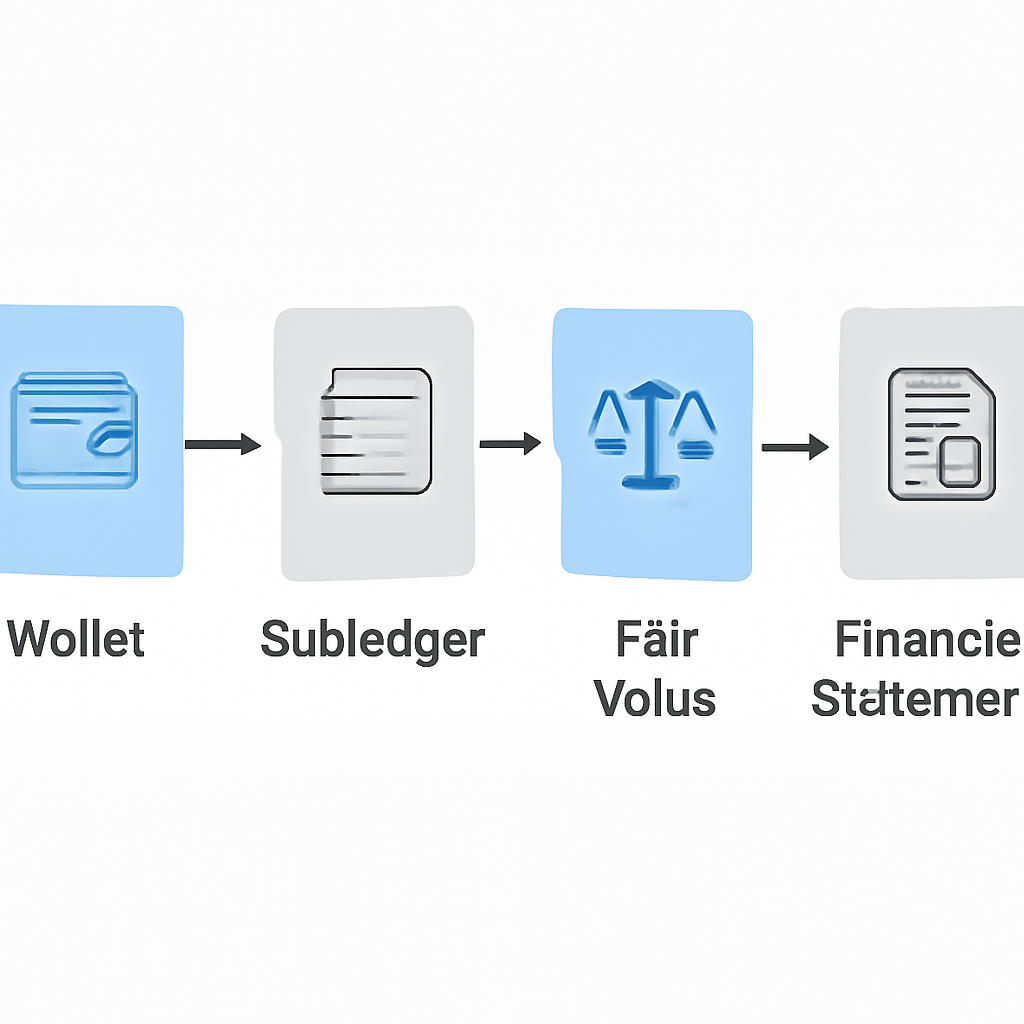
For crypto accounting for accounting firms and in-house finance teams, the capability floor includes automated on-chain data ingestion across multiple blockchains, exchange API connectivity, wallet-level reconciliation, and a configurable sub-ledger that maps crypto movements to a chart of accounts. Cost basis tracking using multiple lot-relief methods is essential, as is the ability to generate gain and loss schedules that can be handed directly to a tax adviser or uploaded to a compliance platform. Audit-readiness is non-negotiable: every transaction needs a timestamp, a source, a valuation, and a clear link to the raw on-chain data.
Beyond the core ledger function, corporate users increasingly need fair value measurement at period-end, currency translation for non-functional-currency holdings, and support for derivative or wrapped-token positions. The ability to produce journal entries in a format compatible with the firm's ERP, whether that is SAP, Oracle, or a mid-market system, is often the deciding factor in whether a treasury team can actually use a crypto-specific sub-ledger in production.
Audit-Ready Sub-Ledger Integration
Integration with a robust crypto sub-ledger and cost basis tracking layer is what separates tools that produce reports from tools that produce defensible, audit-ready financial data. The distinction matters when an auditor asks to see the full transaction history behind a balance sheet figure.
Crypto Treasury Accounting for Accounting Firms
Accounting firms face a specific set of pressures when servicing clients with digital asset holdings. The client wants their crypto treasury handled with the same rigour as their fiat positions. The firm wants to deliver that without creating an unsustainable manual workload or taking on disproportionate liability for errors in data it cannot easily verify.
Multi-Client Workflow Requirements
Crypto accounting for accounting firms therefore needs to be designed with multi-client workflows in mind. A partner or manager overseeing several corporate treasury clients cannot afford to run a different reconciliation process for each one. The software needs to centralise data ingestion, standardise the chart of accounts mapping, and produce client-ready outputs without requiring a specialist blockchain analyst on every engagement. This is where purpose-built platforms differ most sharply from cobbled-together spreadsheet workflows.
There is also a revenue angle. Firms that can confidently offer crypto treasury accounting services, backed by reliable tooling, are positioned to win mandates from clients who are currently underserved. The demand exists. Many corporate treasury teams know their current crypto accounting process is inadequate. They are looking for an adviser who can come in with a credible methodology and the software to support it.
Revenue Opportunity for Firms
| Firm Capability | Without Dedicated Web3 Accounting Software | With Dedicated Web3 Accounting Software |
|---|---|---|
| Transaction data ingestion | Manual export and import; prone to gaps | Automated via API and on-chain feeds |
| Cost basis calculation | Spreadsheet formulas; high error risk | Configurable lot-relief engine with audit trail |
| Period-end fair value | Manual price sourcing and journal entries | Automated price feeds with configurable sources |
| Audit trail | Fragmented across files and emails | Centralised, timestamped, linked to source data |
| Multi-client scalability | Linear increase in effort per client | Standardised workflows across client portfolio |
Crypto Fund Accounting Software: A Related but Distinct Need
Crypto fund accounting software addresses a closely related but structurally different problem. A corporate treasury holds crypto as part of a broader balance sheet. A crypto fund holds it as the primary asset class, with NAV calculation, investor allocations, performance attribution, and regulatory reporting layered on top. The accounting complexity scales significantly when you add multiple share classes, carried interest calculations, and the need to produce fund-level financials for investors and administrators.
Additional Fund Accounting Needs
Crypto accounting for funds requires the same foundational capabilities as corporate treasury accounting: reliable data ingestion, cost basis tracking, and standards-compliant valuation. But it also needs NAV per unit calculation at each valuation point, the ability to allocate income and gains across investors, and integration with fund administration and depositary workflows. DeFi positions, staking income, and liquidity pool holdings add further complexity because their economic substance does not map cleanly to traditional fund accounting concepts.
Hybrid Stack Architecture
Finance teams at crypto-native asset managers are often running hybrid stacks: a specialist crypto data layer feeding into a more traditional fund accounting system. Web3 accounting software that can operate as that data layer, producing clean, reconciled, standards-compliant inputs for downstream systems, is increasingly the architecture of choice.
Regulatory Drivers Accelerating Adoption
The regulatory environment is pushing corporate treasuries and their advisers toward better tooling whether they are ready or not. Reporting frameworks such as CARF and DAC8 require the automatic exchange of crypto asset account information between tax authorities. Companies that cannot produce accurate transaction histories and cost basis data on demand are exposed, both to tax authority scrutiny and to audit qualifications.
Impact of CARF and DAC8
MiCA, now largely in effect across the European Union, imposes prudential and operational requirements on crypto asset service providers that have downstream consequences for their corporate clients. Corporates receiving crypto payments from MiCA-regulated counterparts need their own accounting infrastructure to match the standard of data their counterpart is now required to maintain.
MiCA and US Compliance Deadlines
In the US, the introduction of broker reporting requirements and the FASB's updated guidance on fair value accounting for crypto assets has created a compliance deadline that finance teams are now working against. Getting web3 accounting software in place before a regulatory event is materially easier than retrofitting a compliant process after one.
Illustrative Scenario
This scenario is illustrative. It does not describe a real person or client, and the figures are examples only.
To illustrate how this applies in practice, consider the following scenario:
Priya is the Group Financial Controller at a mid-sized technology company headquartered in London. The company began accepting Bitcoin as payment from international clients and has accumulated a meaningful crypto balance over eighteen months. Priya's team has been reconciling the position manually, using a combination of exchange exports and a spreadsheet model built by one of the senior accountants. The year-end audit is approaching and the external auditors have flagged that they cannot sign off on the crypto balance without a complete, independently verifiable transaction history linked to a defensible cost basis calculation.
Priya implements CryptaCount, connecting the company's exchange accounts and self-custody wallets via API. The platform ingests the full transaction history, applies FIFO lot relief in line with the company's accounting policy, and generates a period-end gain and loss schedule alongside the journal entries needed to update the general ledger. The audit team receives a structured data export with every transaction timestamped and sourced. The sign-off that had been at risk is completed without further queries. Priya's team now runs the monthly crypto reconciliation in a fraction of the time it previously required.

Frequently Asked Questions
What is web3 accounting software?
Web3 accounting software is purpose-built tooling that ingests on-chain and exchange data, applies accounting standards-compliant treatment to digital asset transactions, and produces sub-ledger outputs, gain and loss schedules, and journal entries that can feed into a company's main financial reporting system. It differs from generic accounting software in its ability to handle blockchain-native data structures, continuous settlement, and crypto-specific asset types such as staking rewards and DeFi positions.
How does crypto treasury accounting differ from standard treasury management?
Standard treasury management deals with assets that have centralised custodians, standardised identifiers, and intraday settlement finality. Crypto treasury accounting must handle decentralised custody, wallet-level tracking, continuous settlement across multiple blockchains, and fair value measurement for assets that can move significantly in short periods. The volume of individual transactions can also be orders of magnitude higher than in a traditional cash or bond portfolio.
Which accounting standards apply to corporate crypto holdings?
Under IFRS, most corporate crypto holdings are treated as intangible assets under IAS 38, with cost less impairment as the default model and a revaluation option where an active market exists. Entities holding crypto as inventory may apply IAS 2. Under US GAAP, FASB ASU 2023-08 introduced mandatory fair value accounting for certain in-scope crypto assets. The applicable standard depends on the entity's reporting framework and the nature of its holdings.
What should a crypto accountant look for in a software platform?
A crypto accountant evaluating software for corporate or fund clients should prioritise automated data ingestion from multiple chains and exchanges, configurable lot-relief methods, a clear audit trail linking every figure to its source transaction, and ERP-compatible journal entry outputs. Multi-client workflow support, role-based access controls, and the ability to handle non-standard asset types such as wrapped tokens and staking rewards are important secondary criteria.
Is dedicated crypto accounting software necessary for accounting firms?
For firms with more than one or two crypto clients, dedicated software is effectively necessary. The manual effort of reconciling on-chain data using spreadsheets scales poorly, introduces error risk that creates audit liability, and cannot produce the structured outputs that regulators and auditors now expect. Purpose-built platforms allow firms to standardise their methodology across clients and deliver the service at a margin that makes it commercially viable.
How does crypto fund accounting software differ from corporate treasury tools?
Crypto fund accounting software must support NAV calculation, investor-level allocation of income and gains, multiple share classes, and integration with fund administration and depositary workflows. Corporate treasury tools focus on balance sheet treatment, cost basis tracking, and ERP integration. The foundational data layer is similar, but the reporting and allocation logic for a fund structure is considerably more complex.
What are the main regulatory triggers pushing firms toward better crypto accounting tooling?
CARF and DAC8 require automatic exchange of crypto account information between tax authorities, creating a need for accurate transaction histories that can be produced on demand. FASB ASU 2023-08 introduced fair value accounting obligations for US reporters. MiCA imposes operational standards on crypto service providers in the EU, with knock-on implications for their corporate counterparts. Each of these creates a concrete compliance deadline that makes deferred investment in proper tooling increasingly risky.
Can web3 accounting software handle DeFi and staking positions?
Leading web3 accounting software platforms are designed to classify and account for DeFi interactions, including liquidity pool deposits and withdrawals, staking rewards, yield farming receipts, and protocol fee payments. The key requirement is that the platform can interpret on-chain activity accurately and apply a consistent accounting treatment based on the entity's policy, rather than simply recording raw token movements without context.
Source: CryptaCount