
Crypto Zoho Books Integration: Running a Clean Month-End Close for Crypto Books
Running a month-end close for crypto books is one of the most operationally demanding tasks a finance team faces today. Unlike traditional assets, crypto holdings move continuously across wallets and exchanges, each transaction carrying its own cost basis, tax classification, and fair-value implication. A reliable crypto Zoho Books integration removes the manual bridge between on-chain data and your general ledger, so your close is driven by reconciled sub-ledger data rather than spreadsheet estimates. The same logic applies whether your firm relies on Xero, QuickBooks, NetSuite, or Sage Intacct. Getting the integration architecture right is the foundation of everything else in the close cycle.
Why Crypto Books Demand a Different Close Workflow
Traditional month-end close procedures were designed for assets that sit still. A bank balance reconciles against a single statement. A fixed asset depreciates on a schedule. Crypto does neither. Positions change by the minute, cost basis layers accumulate with every acquisition, and the same wallet may hold tokens that are classified differently under IFRS, US GAAP, or local tax law. This creates three distinct problems for any close team.
First, data completeness is hard to guarantee. Exchanges generate transaction histories in inconsistent formats, DeFi protocols produce on-chain activity that no CSV export will capture automatically, and staking rewards often arrive with ambiguous timestamps that affect accrual timing. Second, cost basis methodology must be applied consistently across every entity and jurisdiction the firm serves. Switching between FIFO, average cost, and specific identification mid-year is not acceptable under any recognised standard. Third, the journal entries that flow into the general ledger must be audit-ready from day one. An auditor asking for a full cost basis trail six months after close should receive a traceable answer in minutes, not days.
A dedicated crypto sub-ledger that feeds directly into the ERP solves all three problems at once. It normalises raw transaction data before it ever reaches the general ledger, enforces a single cost basis methodology, and stores the full audit trail in a structured format that can be interrogated on demand.
Setting Up a Crypto Zoho Books Integration: Core Architecture
A crypto Zoho Books integration works by positioning a crypto sub-ledger as the system of record for all digital asset activity, with Zoho Books receiving only clean, classified journal entries. This matters because Zoho Books, like every cloud accounting platform, was not designed to ingest raw blockchain transactions. Pushing unclassified exchange data directly into the general ledger produces a chart of accounts that is impossible to reconcile and almost certain to generate errors at tax time.
The recommended architecture has three layers. The ingestion layer connects to every exchange API and wallet address the entity uses, pulling transaction data in near real time. The processing layer applies cost basis rules, classifies each transaction by type (disposal, receipt, internal transfer, fee, staking reward), and flags any unmatched or ambiguous events for manual review. The export layer formats the processed data as double-entry journal entries and pushes them into Zoho Books at a frequency that matches your close calendar, typically daily or weekly during the period and then a final reconciled batch at month end.
| Integration Layer | Function | Output to Zoho Books |
|---|---|---|
| Ingestion | Connects exchange APIs and wallet addresses; normalises raw transaction data | Structured transaction feed |
| Processing | Applies cost basis methodology; classifies transaction types; flags exceptions | Reconciled sub-ledger entries |
| Export | Formats double-entry journal entries; maps to Zoho chart of accounts | Audit-ready general ledger postings |
The Month-End Close Checklist for Crypto Books
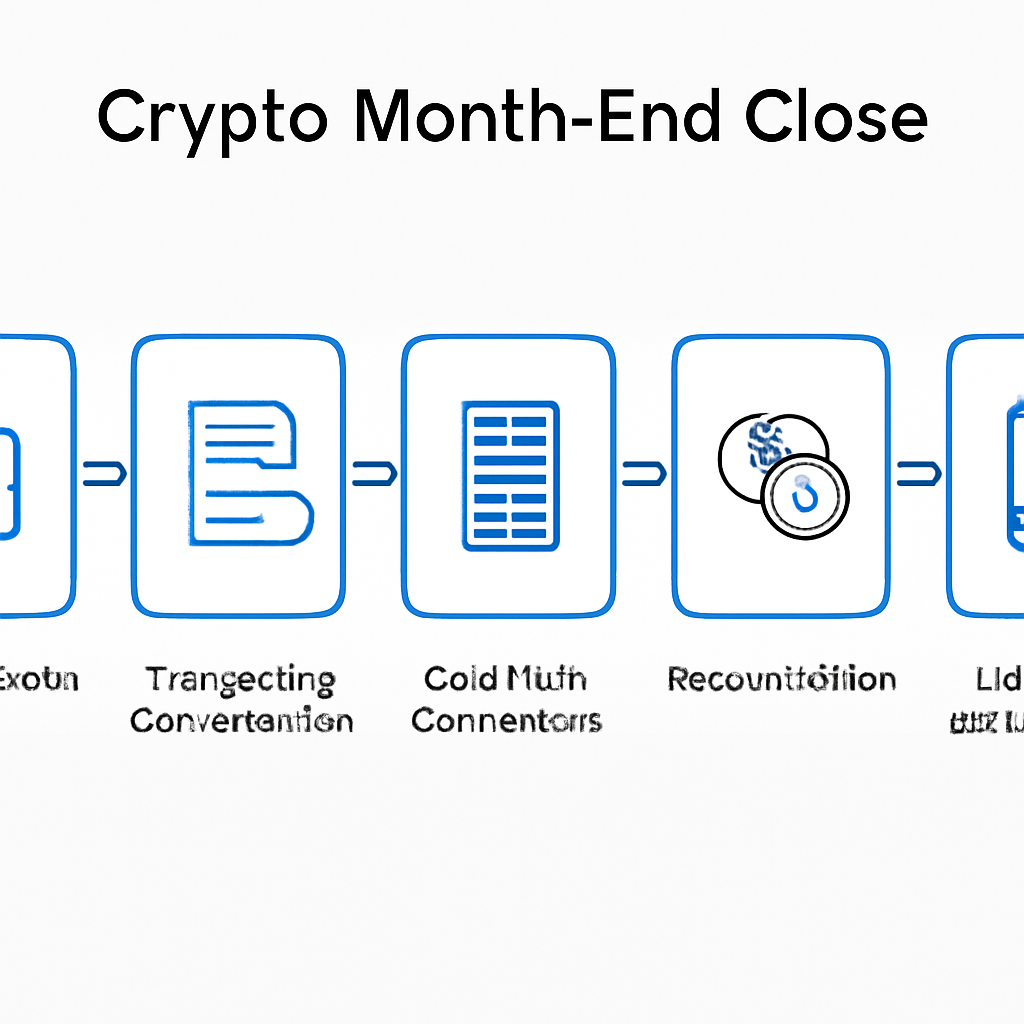
A structured checklist keeps the close on track and ensures nothing falls through the gaps between the crypto sub-ledger and the general ledger. The steps below apply regardless of whether you are running a crypto Zoho Books integration, a crypto Xero integration, or any other ERP connector. The underlying accounting logic is identical; only the export format and field mapping change.
The close begins with a data freeze. At a defined cut-off time on the last day of the period, the sub-ledger stops accepting new transactions for that month. Any exchange activity that posts after cut-off belongs to the following period. This sounds obvious but is frequently mishandled when teams rely on manual CSV exports, because a file downloaded on day two of the new month may include transactions from both periods depending on the exchange's reporting timezone.
After the data freeze, the reconciliation phase begins. Each wallet balance and exchange balance is compared against the sub-ledger's calculated closing position. Discrepancies are investigated and resolved before any journal entries leave the sub-ledger. Only once balances agree does the export process run. The exported journal entries are reviewed by a senior team member, posted to Zoho Books, and then the trial balance is pulled to confirm that digital asset balances on the general ledger match the sub-ledger closing position exactly.
| Close Step | Responsible Party | Key Control |
|---|---|---|
| Data freeze and cut-off | Crypto accounting team | Timezone-adjusted cut-off timestamp applied consistently |
| Exchange and wallet reconciliation | Crypto accounting team | Sub-ledger balance matches live exchange statement |
| Exception review | Senior accountant | All flagged transactions resolved and documented |
| Journal entry export and review | Senior accountant | Double-entry integrity confirmed before posting |
| General ledger posting | Finance controller | Trial balance reconciles to sub-ledger closing position |
| Fair value adjustment | Finance controller | Closing prices sourced from agreed reference feeds |
Crypto Xero, QuickBooks, NetSuite and Sage Intacct: How the Approach Differs
The three-layer architecture described above applies to every major accounting platform, but the practical configuration varies in ways that matter to the teams doing the work.
Crypto Xero Integration
A crypto Xero integration is the most common configuration for small to mid-size accounting firms in the UK, Australia, and New Zealand. Xero's open API is well-documented and supports manual journal imports via CSV as well as direct API posting. The main challenge is chart of accounts mapping: firms often need to create dedicated tracking categories for each digital asset class to maintain the granularity required for tax reporting.
Crypto QuickBooks Integration
A crypto QuickBooks integration is dominant among US-based SME clients. QuickBooks Online supports journal entry imports but imposes rate limits on API calls that can slow high-volume transaction feeds. Firms handling clients with active trading histories should test throughput before relying on real-time sync. QuickBooks Desktop users face additional constraints because the API surface is far more limited than the cloud version.
Crypto NetSuite Integration
A crypto NetSuite integration suits larger enterprises and multi-entity structures. NetSuite's SuiteScript framework allows custom automation logic, which means cost basis methodology rules can be enforced at the ERP level as a secondary control. The trade-off is implementation complexity: a NetSuite integration typically requires a dedicated technical resource and a longer setup timeline than Xero or QuickBooks.
Crypto Sage Intacct Integration
A crypto Sage Intacct integration is increasingly common in the US non-profit and mid-market space. Sage Intacct's dimensional accounting model is well-suited to multi-entity crypto reporting because dimensions can be used to segment activity by asset type, wallet, or business unit without creating an unwieldy chart of accounts. The platform's API supports batch journal entry posting, which aligns well with the monthly export pattern most close teams use.
Cost Basis Methodology and Fair Value at Close
Choosing a cost basis methodology is a one-time decision with permanent consequences. Once your firm has adopted FIFO, average cost, or specific identification for a client, switching requires a formal accounting policy change and, in most jurisdictions, disclosure. The crypto sub-ledger must enforce the chosen methodology consistently across every transaction in the period, and the audit trail must demonstrate that enforcement clearly.
Fair value measurement at month end is a separate but related challenge. For assets carried at fair value through profit or loss under IFRS 9 or measured at fair value for US GAAP disclosure purposes, the closing price used to revalue the position must come from a defensible source. That typically means a principal market price from a regulated exchange or a volume-weighted average from an aggregator, applied at a consistent time each month. The source, the timestamp, and the methodology should all be documented and stored alongside the journal entry in the sub-ledger record.
For accounting firms building an crypto sub-ledger and cost basis reconciliation capability for clients, standardising both the methodology and the price feed across the client portfolio reduces review time significantly. A reviewer who knows that every client uses the same reference feed and the same cut-off time can move through the close pack much faster than one who must verify bespoke arrangements for each engagement.
Audit-Readiness and the Documentation Stack
An audit-ready close does not happen at year end. It is built transaction by transaction throughout the year, and the month-end close is the point at which that build is tested. Auditors reviewing a crypto-holding entity will typically want to trace a sample of transactions from the original exchange confirmation through the sub-ledger classification and cost basis calculation to the general ledger posting. If any link in that chain is missing, the audit becomes significantly more expensive and time-consuming for both sides.
The documentation stack that supports an audit-ready close includes: the original exchange or blockchain transaction record; the sub-ledger entry showing how the transaction was classified and the cost basis applied; the journal entry exported to the general ledger; and the fair value source used for any revaluation at period end. All four elements should be retrievable by transaction reference without manual intervention. This is precisely the kind of operational discipline that differentiates firms that have invested in a proper crypto accounting workflow from those still relying on spreadsheets.
Illustrative Scenario
This scenario is illustrative. It does not describe a real person or client, and the figures are examples only.
To illustrate how this applies in practice, consider the following scenario: Priya is the finance controller at a mid-size accounting firm based in London. The firm has taken on three new crypto-native clients in the past year, each holding assets across multiple exchanges and self-custody wallets. Before implementing a structured workflow, her team was spending the first week of every month manually downloading CSVs, reconciling wallet balances in Excel, and keying journal entries into Xero. Errors were common, and the audit pack for the first client took three weeks to prepare.
After deploying CryptaCount with a crypto Xero integration, the ingestion layer connects automatically to each client's exchange APIs and wallet addresses. Transactions are classified and cost-basis-matched in the sub-ledger throughout the month. On the last working day, Priya's team runs the reconciliation check, reviews exceptions flagged by the system, and approves the journal entry export. The entire close for all three clients now takes less than two days. The audit pack for the second year-end was assembled in under four hours because every transaction link in the documentation stack was already stored and retrievable.

Frequently Asked Questions
What is a crypto Zoho Books integration and how does it work?
A crypto Zoho Books integration connects a crypto sub-ledger to your Zoho Books general ledger, so that classified and reconciled journal entries are pushed automatically rather than entered manually. The sub-ledger handles transaction ingestion, cost basis calculation, and classification, while Zoho Books receives only clean, double-entry postings. This eliminates the manual data transfer step that causes most close errors.
Can I use the same close process for a crypto Xero integration and a crypto QuickBooks integration?
The underlying accounting logic is identical across all platforms: data freeze, reconciliation, exception review, journal entry export, and general ledger posting. The practical differences lie in API configuration, chart of accounts mapping, and export format. A well-designed crypto sub-ledger can generate platform-specific exports from the same underlying data, so the close workflow itself remains consistent.
Which cost basis method should I use for crypto books?
The right method depends on the jurisdiction and the applicable accounting standard. FIFO is the most widely used default, but average cost is also acceptable under IFRS and in several jurisdictions for tax purposes. Specific identification offers the greatest flexibility but requires the most documentation. Whatever method is chosen, it must be applied consistently and documented in the accounting policy.
How do I handle staking rewards in the month-end close?
Staking rewards are typically recognised as income at the point of receipt, with the fair value at that moment establishing the cost basis for any future disposal. The challenge is that rewards often arrive in small, frequent amounts that can be difficult to match to a precise market price. A crypto sub-ledger should capture the timestamp of each reward receipt and apply a consistent price feed to determine fair value at that moment.
What documentation does an auditor need for crypto transactions?
Auditors typically require the original exchange or blockchain transaction record, the sub-ledger classification and cost basis calculation, the journal entry posted to the general ledger, and the fair value source used for any period-end revaluation. All four elements should be traceable by transaction reference without manual reconstruction. Firms that maintain this stack throughout the year face significantly shorter and lower-cost audits.
How does a crypto NetSuite integration differ from smaller ERP connectors?
A crypto NetSuite integration is generally suited to larger, multi-entity structures where custom automation logic can be embedded directly into the ERP using SuiteScript. The setup is more complex and time-consuming than a Xero or QuickBooks connector, but the payoff is a tighter integration between cost basis enforcement in the sub-ledger and secondary controls at the general ledger level. Implementation typically requires a dedicated technical resource.
What is the biggest risk in a manual crypto month-end close?
The biggest risk is cut-off error, specifically, the inclusion of transactions from the wrong period because exchange data is downloaded after the period end. This is compounded when exchanges report in different timezones, making it easy to include activity that belongs to the following month. An automated sub-ledger with a defined, timezone-adjusted cut-off timestamp eliminates this risk by freezing the data at the correct moment.
Is a crypto Sage Intacct integration suitable for non-profit organisations?
Yes. Sage Intacct's dimensional accounting model is particularly well-suited to non-profits that hold crypto because dimensions can be used to segment activity by fund, asset type, or program without expanding the chart of accounts. The platform's batch journal entry API also aligns well with the monthly export pattern most finance teams use. Firms serving non-profit clients with crypto holdings should evaluate Sage Intacct as a primary ERP target.
Source: CryptaCount