
Crypto Audit Software: Meeting Switzerland's Accounting Requirements
Switzerland has long positioned itself as one of the most crypto-progressive jurisdictions in the world, yet that reputation comes with a rigorous set of accounting and audit obligations that many firms still underestimate. For any crypto audit software buyer evaluating their options, Switzerland is a useful benchmark: the standards it applies to digital asset reporting, valuation, and disclosure are among the most demanding anywhere. Accounting firms, fund auditors, and CFOs operating in or servicing Swiss-domiciled entities need to understand exactly what is required and how the right tooling makes the difference between a clean audit opinion and a qualified one. This article sets out what Swiss frameworks demand, where manual processes break down, and what good looks like when firms equip themselves properly.

Why Switzerland Sets a High Bar for Crypto Accounting
Switzerland's financial regulator, FINMA, and the country's Code of Obligations together create a layered compliance environment for entities holding or transacting in digital assets. Swiss generally accepted accounting principles require true and fair presentation of financial position, and digital assets do not get a pass on that requirement simply because they are novel. Entities must classify crypto holdings correctly, apply consistent valuation policies, and disclose material positions in a way that gives users of the accounts a genuine picture of economic reality.
The Swiss approach to crypto classification draws on whether a holding is a payment token, utility token, or asset token, and each category can attract different accounting treatment under Swiss GAAP or IFRS as adopted by listed entities. A payment token held speculatively by a trading desk is treated very differently from a utility token issued by a platform or a tokenised security held by a fund. Getting that classification right at the point of initial recognition is not optional. It shapes everything from the balance sheet line item to the impairment test to the audit evidence an auditor must obtain.
For accounting firms and auditors servicing Swiss clients, the burden is twofold. They must ensure their own methodologies are up to date and they must be able to demonstrate to regulators that client-facing work meets the standard. Crypto compliance reporting infrastructure is no longer a nice-to-have in this environment. It is a prerequisite.
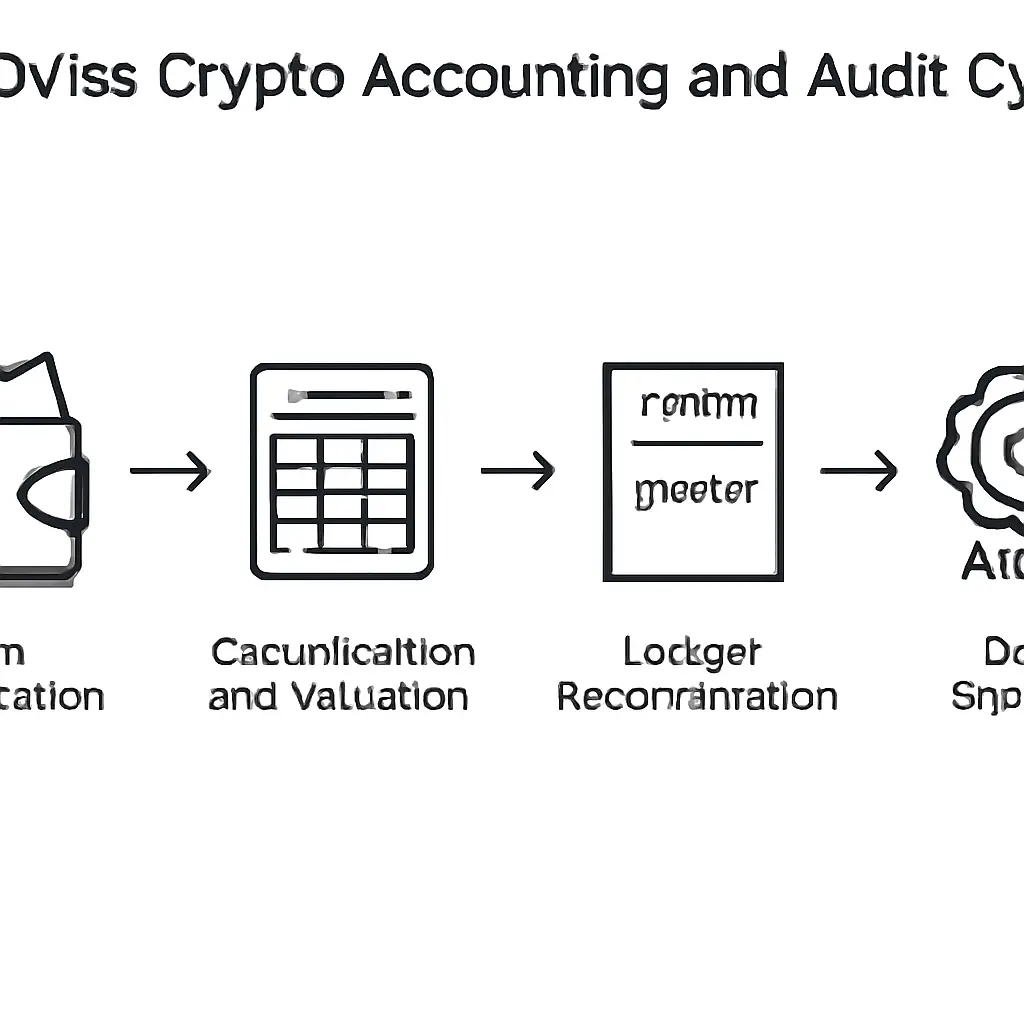
The Core Audit Challenges Specific to Digital Assets
Auditing crypto holdings is categorically different from auditing a bond portfolio or a property fund. The audit evidence challenge is immediate. Traditional confirmation procedures, where an auditor writes to a custodian and receives a signed balance confirmation, do not translate neatly to self-custodied wallets or DeFi positions. Auditors must instead verify on-chain data, reconcile wallet addresses to client assertions, and assess whether the entity actually controls the private keys associated with declared holdings.
Valuation is a second pressure point. Crypto assets can trade on dozens of exchanges simultaneously, with price feeds differing across venues. A Swiss entity holding a mid-cap token at year-end faces a genuine question about which price to use, and the auditor must assess whether management's chosen methodology is reasonable, consistently applied, and adequately disclosed. Where a client holds illiquid or thinly traded tokens, the valuation challenge escalates significantly and may require specialist input.
Transaction volume creates a third layer of complexity. A fund executing thousands of trades per month across multiple chains and exchanges cannot be audited through manual sampling alone. The error rate on manual reconciliations at that volume is simply too high. Auditors who rely on client-prepared spreadsheets without independent data verification are taking on unacceptable risk. This is precisely where purpose-built crypto audit software earns its place: it ingests raw on-chain and exchange data independently, reconstructs transaction histories, and produces audit-ready outputs that stand up to scrutiny.
Key audit risk areas by asset type
The table below summarises where audit risk concentrates depending on the type of digital asset held by a Swiss entity.
| Asset Type | Primary Audit Risk | Valuation Approach | Disclosure Requirement |
|---|---|---|---|
| Payment tokens (e.g. BTC, ETH) | Custody verification, impairment testing | Market price at reporting date | Accounting policy, fair value movement |
| Asset tokens (tokenised securities) | Classification, regulatory status | Underlying asset value | Nature of rights, issuer information |
| Utility tokens | Existence, collectability | Cost or net realisable value | Material uncertainty if illiquid |
| DeFi positions | Control assessment, smart contract risk | Fair value of underlying liquidity | Off-balance-sheet risks, concentration |
| Fund crypto holdings | NAV accuracy, investor reporting | Per fund prospectus policy | Full position-level disclosure |
What Swiss GAAP and IFRS Require from Crypto Accountants
A qualified crypto accountant working under Swiss GAAP operates within a framework that has not yet issued dedicated crypto-specific standards, which means professional judgement fills the gaps. The Swiss accounting standards setter has provided guidance that leans toward treating most crypto assets as intangible assets under Swiss GAAP, measured at cost less impairment. However, entities can elect fair value measurement in certain circumstances, particularly where the asset is actively traded and a reliable market price exists.
For entities reporting under IFRS, the picture is different. IAS 38 on intangible assets has been the default classification for cryptocurrencies in the absence of a specific standard, though the IASB's agenda project on crypto assets is expected to produce targeted guidance. Entities holding crypto as inventory, because their business model involves trading or brokering, may apply IAS 2 instead. The classification choice has direct consequences for whether gains are recognised in profit or loss or sit in other comprehensive income, and the audit trail must reflect whichever policy is adopted.
Crypto accounting for accountants in Swiss practice therefore demands not just technical knowledge of the standards but also the ability to document the rationale for each classification decision. Audit committees and regulators will ask why a particular treatment was chosen, and a well-maintained accounting policy note supported by software-generated evidence is far more defensible than a post-hoc explanation.
How Crypto Accounting for Funds Differs from Corporate Clients
Crypto accounting for funds introduces a layer of complexity that corporate engagements do not face. A Swiss-domiciled crypto fund, whether regulated under FINMA's collective investment schemes framework or structured as a limited partnership, must calculate net asset value with precision at each valuation point. Investors rely on NAV to make subscription and redemption decisions, and any error in the underlying crypto accounting flows directly into investor harm and potential liability for the fund administrator.
Crypto fund accounting software must therefore handle not just transaction-level data but also the attribution of income, fees, and unrealised gains across multiple share classes. This is computationally intensive when a fund holds hundreds of positions across multiple chains. Manual reconciliation is not realistic at scale, and the administrator's auditor will expect to see a robust, auditable data trail from raw transaction data through to the final NAV figure.
The table below compares key accounting requirements between a standard corporate crypto holder and a regulated crypto fund in Switzerland.
| Requirement | Corporate Entity | Regulated Crypto Fund |
|---|---|---|
| Valuation frequency | At least annually (year-end) | Per fund documents, often daily or weekly |
| Cost basis method | FIFO or weighted average | Per prospectus, must be consistently applied |
| Investor reporting | Not applicable | Per share class, audited annually |
| Regulatory audit requirement | Statutory audit if above thresholds | Mandatory annual audit by approved auditor |
| Impairment testing | Required under Swiss GAAP | Fair value through P&L typically |
What Crypto Accounting for Accounting Firms Looks Like in Practice
Accounting firms in Switzerland serving crypto-active clients face a client-demand problem and a capacity problem simultaneously. The demand problem is straightforward: as more clients hold digital assets, either on corporate balance sheets or within fund structures, the firm needs to deliver accurate, timely accounting without acquiring specialist staff for every engagement. The capacity problem follows: the volume of transaction data generated by a single active crypto client can overwhelm a team accustomed to bank statement reconciliations.
Purpose-built crypto accounting for accounting firms addresses both problems. The right platform integrates directly with exchanges and wallets, pulls transaction data automatically, applies the firm's chosen cost basis methodology, and generates trial-balance-ready outputs. The auditor or accountant then reviews exceptions and policy decisions rather than manually keying in thousands of transactions. That shift from data entry to professional judgement is where the real value lies.
Firms that invest in this capability also unlock an advisory revenue opportunity. Clients who are unclear about their crypto accounting treatment, or who are facing a first-time audit of digital assets, will pay for guidance. A firm that has already systematised its approach can deliver that guidance efficiently and position itself as the go-to practice for crypto-active businesses in its region.
Selecting the Right Crypto Audit Software: What to Look For
Not all crypto audit software is built to the same standard, and the Swiss market specifically rewards platforms that can handle the jurisdiction's complexity. There are several practical criteria that matter.
First, the platform must support multi-chain data ingestion. A Swiss crypto fund or corporate treasury will hold assets across Ethereum, Bitcoin, and potentially several layer-two or alternative networks. Any software that covers only a subset of those chains creates gaps in the audit trail that the auditor then has to fill manually, which defeats the purpose.
Second, the software must apply a documented, reproducible cost basis methodology. Whether the client uses FIFO, LIFO (where permitted), or weighted average, the calculation must be traceable from raw input to reported output. Audit software that cannot show its working is not audit software in any meaningful sense.
Third, the platform should produce outputs that map to Swiss GAAP or IFRS line items directly. Auditors should not have to reformat data to fit the client's chart of accounts. The closer the software output is to the final financial statement presentation, the shorter the path from data to opinion.
Fourth, consider whether the platform supports the specific fund accounting needs described above, including NAV calculation, multi-class attribution, and investor-level reporting. Not every crypto audit software product is built for fund administrators, and selecting the wrong tool for a fund engagement creates problems at year-end.
Illustrative Scenario
This scenario is illustrative. It does not describe a real person or client, and the figures are examples only.
To illustrate how this applies in practice, consider the following scenario:
Markus is a partner at a mid-sized Swiss accounting firm in Zurich with a growing number of crypto-active clients, including two regulated funds and several corporate treasury teams. At the start of the previous financial year, his team was spending an average of three weeks per client just reconciling transaction data from exchange CSVs and wallet exports. Audit fieldwork was delayed, and one fund client received a qualified opinion referencing incomplete transaction records.
After onboarding CryptaCount as the firm's crypto audit software, Markus's team connected client wallets and exchange accounts directly to the platform. Transaction histories were reconstructed automatically, cost basis calculations were documented, and the system flagged classification decisions that required partner-level review. For the regulated fund clients, NAV calculations were reconcilable directly to the software output. At the next year-end, audit fieldwork for the same clients completed in under a week, and both fund clients received clean opinions. The firm has since added three new crypto-active clients on the back of its demonstrated capability in this space.
Frequently Asked Questions
What is crypto audit software and why do accounting firms need it?
Crypto audit software is a platform designed to ingest raw blockchain and exchange transaction data, apply accounting policies such as cost basis methods, and produce audit-ready financial outputs. Accounting firms need it because the volume and complexity of digital asset transactions make manual reconciliation unreliable at any meaningful scale. It reduces fieldwork time and strengthens the evidential basis for audit opinions.
How does Switzerland classify crypto assets for accounting purposes?
Under Swiss GAAP, most crypto assets are treated as intangible assets and measured at cost less impairment, though fair value election is available for actively traded assets. Entities reporting under IFRS typically apply IAS 38, though those holding crypto as part of a trading business may use IAS 2. The correct classification depends on the nature of the asset and the entity's business model.
What does a crypto accountant need to know about Swiss GAAP?
A crypto accountant working under Swiss GAAP must understand that no dedicated crypto standard exists, so professional judgement governs classification and measurement. They must document the rationale for each policy choice, apply it consistently, and ensure disclosures reflect the economic substance of the holdings. Regulators and audit committees will scrutinise those decisions during statutory audits.
What makes crypto accounting for funds different from corporate accounting?
Crypto accounting for funds requires frequent NAV calculation, multi-share-class attribution, and investor-level reporting that corporate accounting does not. Fund administrators and their auditors must be able to trace every NAV figure back to underlying transaction data. The stakes are higher because errors flow directly into investor harm and potential regulatory action.
Which cost basis methods are acceptable for crypto accounting in Switzerland?
FIFO and weighted average are the most commonly used methods under both Swiss GAAP and IFRS for Swiss entities. The key requirement is consistent application once a method is chosen. Funds must follow the methodology specified in their prospectus, and any change in policy requires disclosure and, in some cases, regulatory approval.
What audit evidence is required for self-custodied crypto holdings?
For self-custodied assets, auditors cannot rely on third-party confirmations in the traditional sense. Instead, they must verify wallet addresses against client assertions, inspect on-chain transaction records, and assess whether the entity controls the private keys associated with declared holdings. Crypto audit software that independently reconstructs on-chain histories strengthens this process significantly.
How does crypto accounting for accounting firms generate new advisory revenue?
Firms that systematise their digital asset accounting capability can offer crypto classification reviews, first-time audit support, and accounting policy design as discrete advisory services. Clients facing their first statutory audit of crypto holdings are often willing to pay for guidance, and a firm with proven tooling can deliver that guidance efficiently. This positions the practice as a specialist in a growing client segment.
What should firms look for when choosing crypto fund accounting software?
Key criteria include multi-chain data ingestion, support for NAV calculation across multiple share classes, documented cost basis methodology, and outputs that map directly to the fund's chart of accounts. The software should also produce investor-level reporting that aligns with the fund prospectus. Platforms that cover only a subset of chains or lack fund-specific features create gaps that undermine the audit trail.
Is IFRS or Swiss GAAP more appropriate for crypto-active Swiss entities?
The choice depends on the entity type. Listed Swiss companies are required to apply IFRS or Swiss GAAP FER. Unlisted entities and SMEs typically apply Swiss GAAP, which offers more flexibility but less international comparability. Funds often apply IFRS for investor-facing reporting. A crypto accountant should assess which framework applies based on the client's legal form and reporting obligations before determining the appropriate accounting treatment.
Source: CryptaCount